
20+ Popular Turkish Foods To Try Out

Turkish people are exceptionally proud of their cuisine, claiming it is the best in the world. But it’s not just the quality of the ingredients and the range of dishes; great pride is taken in ensuring guests are offered copious amounts.
Food abounds at any social occasion, and groups of family and friends meet regularly for breakfast and conversation in the mornings and for mezes and drinks in the evenings.
The most famous offerings are kebaps and köfte, but the cuisine is so much more than that. From the delicate vegatable dishes to the sugar-soaked desserts, Turkish food is a delectable delight of variety with influences from the Mediterranean to the Middle East and from Central Asia to the Balkans.
All we can do here is offer a glimpse of what is on offer should you have the opportunity to travel to this magical, oriental land.
1. Kebap (yes, with a “p”)
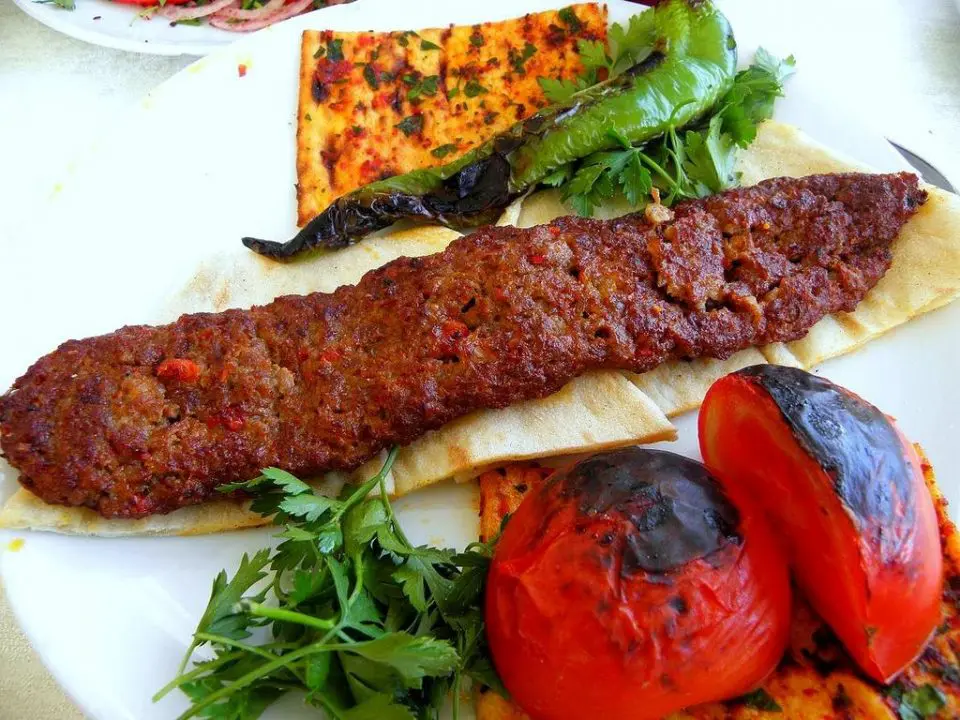
Even its most famous dish is incredibly diverse. Wikipedia lists 37 varieties, using beef, lamb, or chicken either minced, cheese-stuffed kebap, cubed or thinly sliced, either plated or wrapped, and served with salads, sauces and turşu – pickled vegetables such as peppers, cabbage, carrot, and small cucumbers.
The most popular minced meat kebaps are Adana kebabı, spiced minced beef squished onto skewers and cooked over a fire, and Urfa kebabı, a less spicy version.
Şiş, or shish, kebap is succulent, perfectly square cuts of lamb or chicken grilled on skewers. Or have it wrapped in bread and served in a plastic sleeve to catch the dripping fat. The left over bits, the çöp, or rubbish, from making those square lamb chunks are mashed together with garlic and tomato, laced onto skewers, and grilled to make the juicy and so, so delicious çöp şiş kebabı. Mouth watering.

Probably the most well-known kebap, as it’s a favorite in the West after a beer, is the doner (turning), thin slices of lamb or chicken cut from a rotating stack of meat and served in a wrap or bread with salad and topped with sauce: tomato, mayonnaise, or/and yogurt.
For a more appetizing plate of doner meat, sit down to an İskender kebabı. Thin layers of lamb doner rest on a bed of pide bread and are coated with tomato sauce and yogurt. Once served, your waiter will return with a longhandled pot of melted butter to pour over your meal, completing this, very calorific, luscious feast.
2. Dolma

Dolma means filling, so any vegatable can be the base for dolma. Change the suffix, though, and you can say “doldum”, “I’m stuffed”.
Peppers (biber dolması), zucchini (kabak dolması), vine leaves (yaprak dolması), cabbage leaves (lahana dolması), or chard leaves (pazı dolması) are stuffed – the leaves are rolled up, of course – with a mixture of ground beef, spices, and a little rice, then cooked in diluted tomato paste.
There’s a vegetarian stuffing too, with a base of sautéd onions and tomatoes with rice, spices, pine nuts, and currants, making it sweet and spicy and delicious. Both dolma versions are often served with yogurt.
The origins of dolmas trace back to the Ottoman Empire, and they have since become one of the most popular dishes in Turkey as well as in the Balkans (i.e. sarma), Romania (i.e. sarmale), and various Eastern European and Middle Eastern countries.
3. Köfte
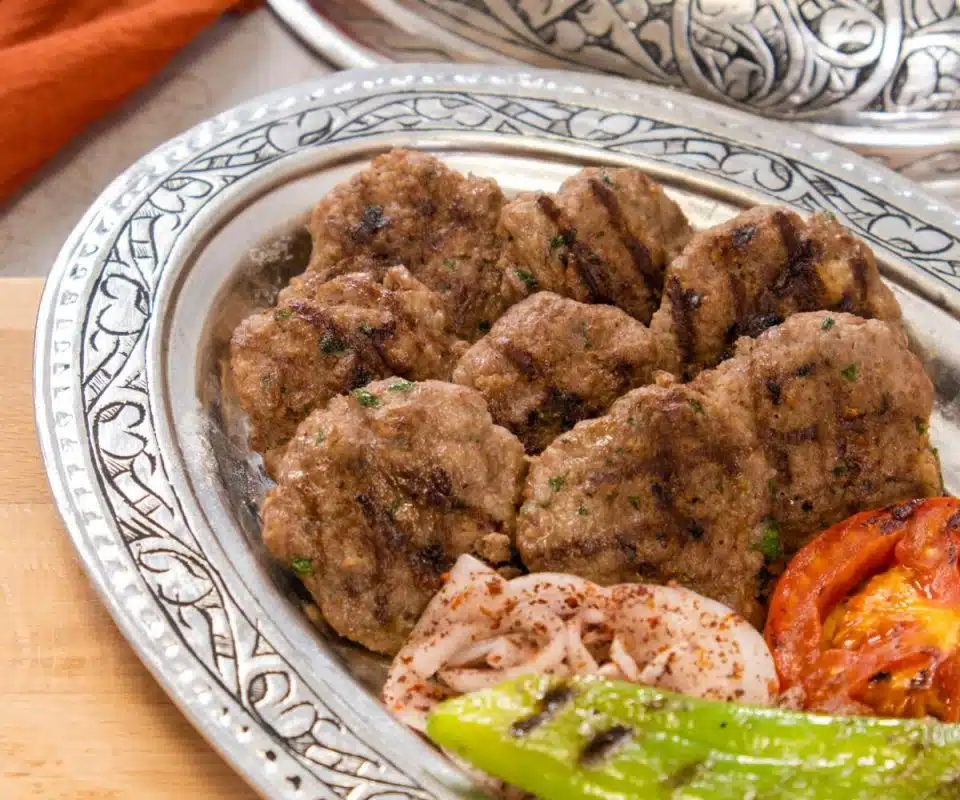
Meat balls. Don’t go into a köfte restaurant expecting anything other than köfte. These restaurants are heaven for the indecisive. The only choices here are whether you have a full or half portion and whether you fancy green salad or piyaz – beans and onions in oil. And don’t expect balls, either.
Köfte is spiced minced beef formed into rolls and fried. To complete the experience, make sure there’s a pot of hot red pepper sauce on the table; it perfectly tangs up the succulent meat.
4. Hamsi (anchovy)

With around 5,000 miles of coastline, fishing is big industry. But the number one favorite fish is hamsi, fresh from the Black Sea. While it can be baked or poached, it’s simply best when it is fried.
This intense flavored little fish is cooked whole, coated in a little flour, and placed in a wheel formation around the frying pan. Once the first side is cooked, place a plate over the top, flip the pan, and slide the wheel of fish back in to cook on the other side. Delicious served with a green salad.
5. Zeytinyağlılar (“those with olive oil”)

Time to feed the vegans. Any restaurant displaying a variety of dishes in the window will also have zeytinyağlılar – vegetable dishes cooked in olive oil and served cold.
The most popular dishes are leek, runner bean, and artichoke, but you can also find eggplant, celeriac, and red and green peppers. Onions and carrots are sautéd in olive oil to form a base to which a single vegetable, not a mix of vegetables, and water is added together with a little rice and lemon juice.
Light and refreshing, they make a great starter or a meal when put them together with bulgur rice. You’ll find them also on the meze menu, but more about mezes later.
6. İmam Bayıldı

This is an eggplant dish. Eggplant features a lot in the Turkish kitchen and this is a very popular version. The eggplant is cut in half lengthwise, slits are cut into the flesh, and it is then fried in olive oil – and, yes, it soaks it up.
The slits are then filled with a tomato and onion sauce with garlic and herbs and the whole thing is baked. Served with good crusty bread and yoghurt, it’s a satisfying tangy, earthy dish.
7. Karnıyarık

As with so much of Turkish cuisine there is a meat version and a veggie version. Karnıyarık is the meat version of İmam bayıldı, cooked exactly the same but with ground beef or lamb in the stuffing. It’s never going to look elegant on the plate but it is a delicious dish, and best served with rice and plain yogurt.
8. Çiğ Köfte (chee kerff-te – raw meatballs)

This one began as a serious meat dish but ended up vegan! A speciality dish of raw mince and spices, it was prepared for special occasions – and still is a some parts of the country. The mince is rubbed with the heel of the hand over bumps on the base of a special round dish as spices and bulgur rice are added.
Today, however, if you buy from any çiğ köfte shop or restaurant, you’ll be getting a purely vegan version using bulgur rice as raw meatballs are now banned in shops and restaurants. But if you travel outside the big centers, be sure to ask first!
Fine bulgur is mixed with onions, tomato and red pepper puree, tomatoes and cumin to make a thick paste that is shaped into rolls and served wrapped in lettuce leaves topped with chilli sauce and a squeeze of lemon. A delicious appetizer.
9. Mantı
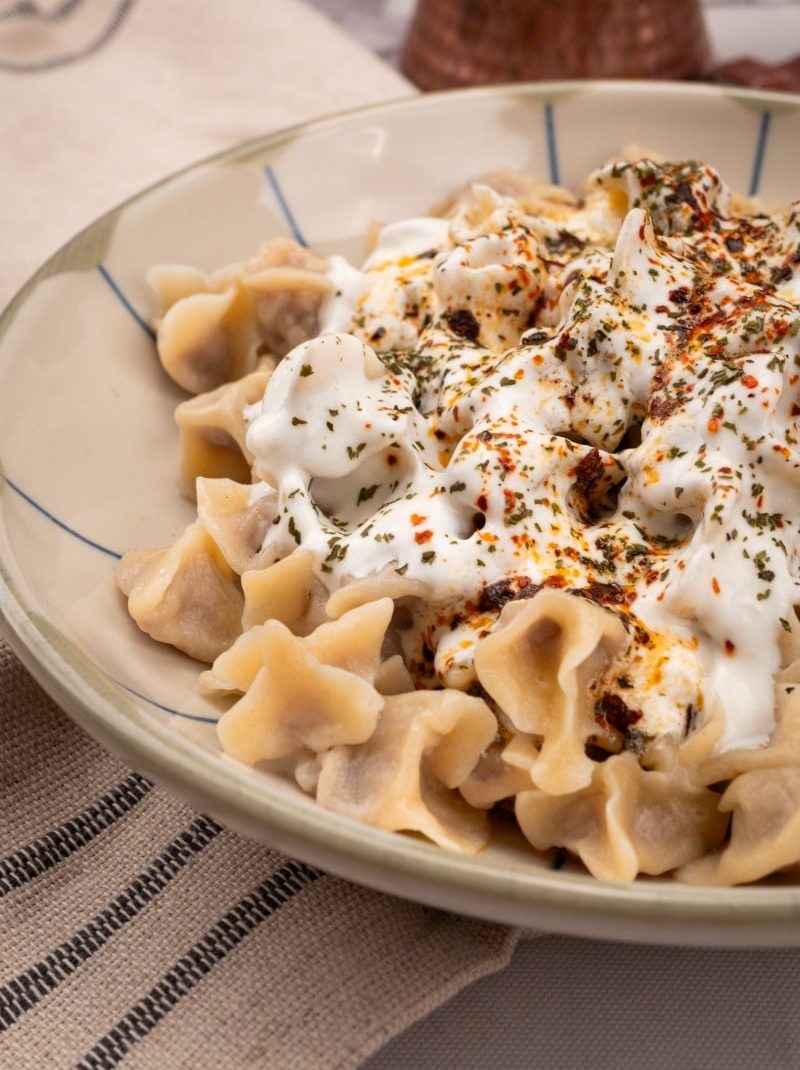
Imagine Italian ravioli made of dough rather than pasta, a third of the size, and topped with tomato sauce, garlic yogurt, and chili pepper infused melted butter. It is heaven. Mantı can be shop-bought, dried in vacuum packs, but the very best is hand made… and homemade, as restaurants can be a bit shy with the garlic.
Lots of small restaurants now have women dressed in village clothing, sitting in the window making mantı the traditional way – rolling out the dough, cutting into squares, pulling off small bits of meat mixture to place on each square, then forming the squares into small, evenly shaped parcels. These women are skilled, their fingers work fast, and it is impressive to watch – if a little voyeuristic.
10. Kahvaltı (breakfast)

The full Turkish breakfast is a sumptuous feast of dishes, the promise of which will get the most resistant early riser out of bed. In an array of small dishes you’ll find salad veg, olives, cheeses, pastes and conserves, kaymak (a thick cream similar to clotted cream) with honey.
Then there are the eggs – boiled, fried on their own or with sucuk (or sujuk – a spicy cured beef sausage), or the delicious menemen very similar to the currently fashionable Arabic shakshuka. And not forgetting the deep-fried section with sigara boreği (cigar-shaped rolls of puff pastry stuffed with cheese and parsley) or the delectable, juicy, best-eaten-as-soon-as-they-arrive, pişi – deep fried balls of bread dough.
It’s a fabulous mix-and-match breakfast served with bread or simit and plenty of tea. Every cafe and restaurant serves its own version and the quality does vary, so be selective. But if you are lucky enough to be in Van in the east of the country (probably not these days), or find a restaurant serving a Van breakfast, do not miss out!
11. Meze
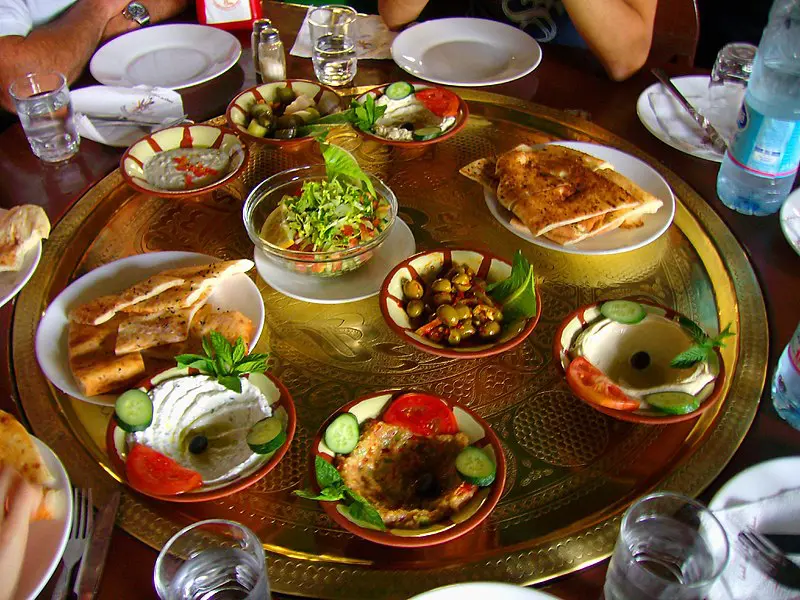
Another meal of small dishes but at the other end of the day, the meze is famously for drinking rakı with, though beer, wine, or water are equally acceptable.
Much like the Spanish tapas and pretty much the same as the Greek meze, the Turkish meze is a selection of salad, fish, and vegetable dishes, all of which can be easily made at home. On long summer evenings sitting out with good friends, the meze is often followed by a full kebap of juicy lamb or beef or yaprak ciğer – very thin slices of liver fried in butter.
12. Gözleme

This is a simple yet delicious snack that was often seen as village food, but is now popular in all towns, cities and holiday areas. A thinly rolled out flat bread is folded up with a filling and fried on a dome-shaped metal plate over a fire.
All you need do is choose your filling. Ispanaklı is spinach, which wilts in the bread as it cooks. It sometimes comes mixed with lor peynir, a salty village cheese, or feta. Or you can have the cheese without the spinach in the peynirli gözleme, which simply means “with cheese”.
Patatesli is the more filling potato version, either prepare with boiled potatoes or grated uncooked potato that heats as the gözleme cooks. And, finally, yeşilikli, or with ‘greens’, that can be anything from parsley to a mix of wild greens.
So easy are they to prepare and the fire to set up that you’ll find them being served at most outdoor events – festivals, markets, along the beach front…
13. Pide

Another flatbread dish but this time thicker, traditionally shaped like a boat, filled with more complex fillings, and baked in a wood-fired oven, producing a crispy, crunchy base.
Pide comes from the Black Sea region but is now a firm favorite throughout the country.
Traditional fillings are sucuklu yumurta, which is a spicy Turkish sausage topped with eggs and cheese, and ispanaklı kaşar, which is spinach and kaşar, a yellow, sheep’s cheese.
Restaurants offer many other fillings, and they are all delicious, so you’ll have to keep going back to try them all.
14. Lahmacun

Yet another iteration on what to do with dough, this dish is often called the Turkish pizza.
It is very much like a pizza too. The dough is left flat, the filling is placed on top, and the whole thing is baked – the best are baked in wood-fired ovens.
The filling is a mix of mince, tomato paste, garlic, and spices that is spread over the dough. You can ask for an acılı lahmacun, which is with the addition of chili pepper to spice it up.
The base is thinner than a thin pizza and the topping is just the paste topping – nothing fancy. So, once served, you can dress it with parsley, onion, more dried chili, and a squeeze of lemon, then roll it up and eat it wrapped in a napkin. Ayran goes well with it.
You will find lahmacun salons that sell, well, pretty much nothing but lahmacun. They are small and crowded, so you squeeze yourself into a seat and the waiters squeeze themselves around the tables. Eating here is a social, lively and noisy experience – and well worth it.
15. Börek

There is no one börek that epitomises börek. Borek is more a family of snacks that are made with layers of thin pastry known as yufka, a bit like puff pastry, but only a bit.
It is the same stuff that baklava is made with, but börek is usually savory.
There is sigara böreği, a single triangle of yufka rolled up with cheese inside and deep fried – the shape of a cigarette. There is paçanga böreği, a larger roll filled with meat or cheese, diced tomatoes and green peppers and fried.
Gül böreği is so called as a long sausage of filled yufka is shaped into a spiral resembling a rose (gül). You’ll find this in bakeries, and it can be filled with spinach, cheese, or potatoes.
Then there is the delicious su böreği. This literally means water börek, so called because the yufka is first briefly boiled in water before being filled and baked.
I said börek is usually savory. But there is a sweet börek, Kürt böreği, from the Kurdish regions, which is plain baked yufka sprinkled with icing sugar. Ask for it at any small eatery.
16. Künefe

The Turks know what to do with sugar. A nation with a sweet tooth, they have devised wonderful ways of consuming the stuff.
Künefe is a mouth-watering masterpiece that is becoming popular in the West. But, really, the offerings here don’t compare with the traditional, authentic version you can find in small cafes and restaurants in Turkey.
Individual künefe pans are coated with butter-soaked shredded dough, then cheese, such as mozarrella, is sprinkled on top, and this is covered with another layer of shredded dough, packed down tightly.
It is cooked on the stove with another pan on the top, and when the bottom has browned, it is flipped for the other side to cook.
The final step is pouring over a sweet sugar syrup and leaving it a few minutes to absorb. Decorated with chopped pistachios, it is served warm, and you will never forget the first time you bring your first bit of stretchy cheesy künefe to your lips.
17. Baklava
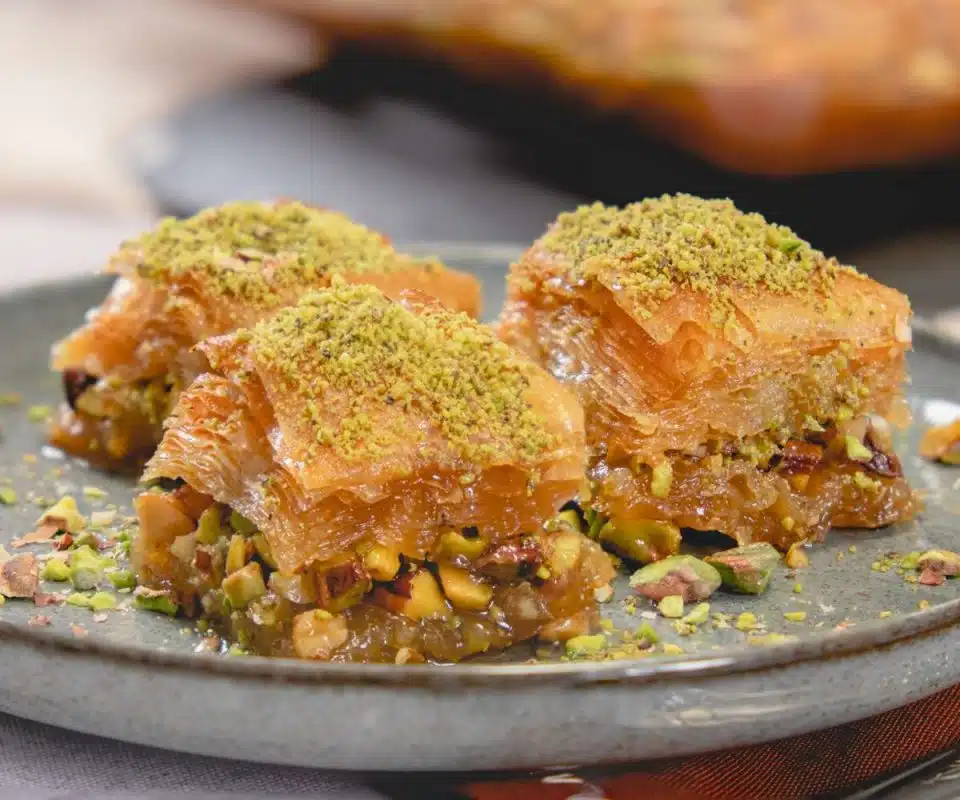
Crispy and crunchy, soft and succulent, nutty, sweet and sticky: that is baklava.
It is superior, sophisticated and sought after, because it is never quite the same when bought at home as it is when you bit into it while travelling in Turkey.
And if you are travelling in Turkey, then lucky you, as you can try out all the different types of Turkish baklava.
Layers and layers of almost translucent yufka pastry are topped with with pistachios – fine ground, medium ground, and thick ground – and then covered with more layers of yufka. Melted butter is poured over the top and it’s then baked in a wood-fired oven. Once out, sugar syrup is poured over it and allowed to soak in. It is really a heavenly delight, rich and wonderful.
There is a lighter version, sütlü nuriye, where the sugar syrup is replaced with sweetened milk. This makes it much fresher and less sweet somehow. And then there are versions using walnuts instead of pistachios.
Whether cut into squares or triangles, baklava really is the ultimate in decadent desserts. But if you are thinking of bringing some home with you from your foreign travels, it doesn’t last long – just 3-5 days.
So it’s just as well there is kuru baklava, or dry baklava, which uses less syrup preventing it crystallize. This will last up to 30 days so you can bring some home as gifts – if you don’t open it up before seeing your friends.
18. Ekmek Kadayif

The Turkish take on bread pudding is ekmek kadayıfı. It used to be made with leftover bread but the special, crumtpety-type bread is often specially prepared today.
Once cooked, the bread is sliced vertically through the middle and the two pieces are put back together with a layer of kaymak, very similar to clotted cream.
If you are reading through these dessert resipes, you will know by now that the next step is to soak the whole thing in sugar syrup and decorate it with pistachios. It is moist and sweet and delicious.
19. Şekerpare
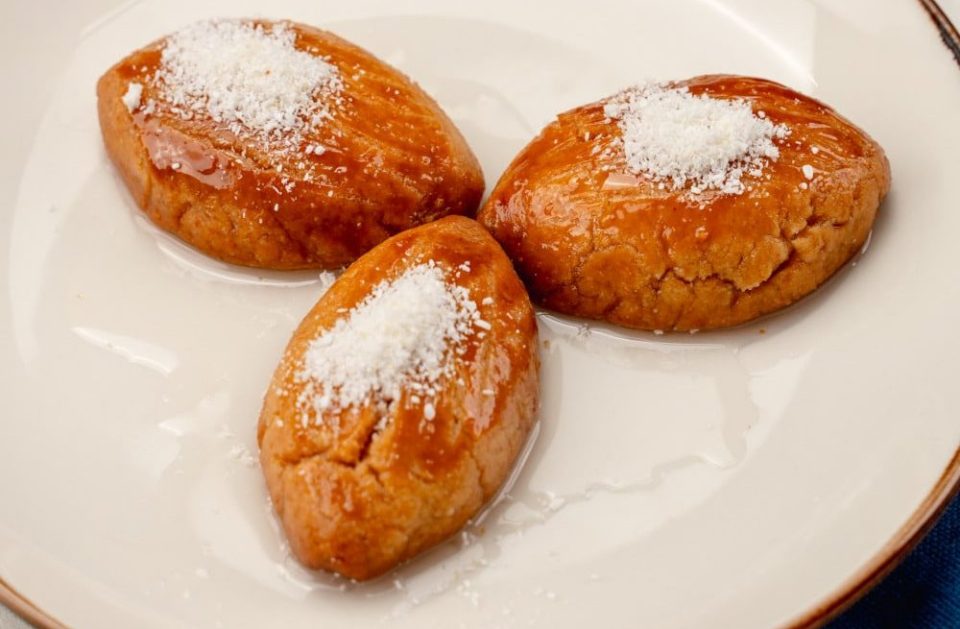
Another base for sugar syrup – and why wouldn’t we want one? – is şekerpare.
These small almond-flavored cookies are soaked in syrup, making them moist and melt-in-the-mouth. With a little sprinkling of dessicated coconut they make a delightful dessert.
20. Ayva Tatlısı (Quince Pudding)

Raw quince can be tart and tough so they are most often cooked to bring our their sweet and delicate flavor.
Ayva tatlısı is a popular winter dessert in Turkey, where the quince are boiled in syrup with cloves and cinnamon. The long cooking process transforms the quince into a soft and delicate ruby-colored dessert.
Best topped with kaymak and a sprinkling of chopped pistachios, of course.
21. Dondurma

If you are in Turkey, visit Mado, an ice-cream and pastry palor with outlets across the country. There you can pour over a menu with pages and pages of wonderful ice-cream treats, from single scoops to mixed flavored cakes.
Well, not cakes, really. But ice-cream so thick it looks like and is sliced like a cake. Turkish ice-cream, dondurma, is unique, containing salep, from the root of an orchid, and mastic, a plant resin, that gives it a thick and chewy texture.
22. Lokma & Tulumba
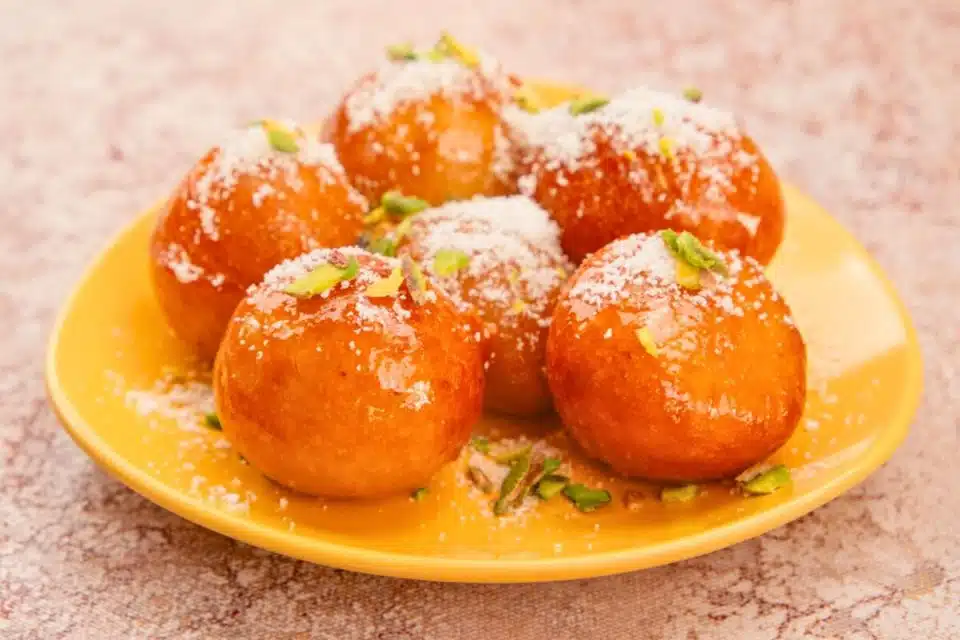
And if that isn’t enough sugary-syrupy calories for you, perhaps go syrup and deep fried. Lokma, small balls of deep fried leaved dough covered in syrup, or tulumba, a thinner dough syringed into hot fat and soaked in syrup – a very popular street food in Turkey.
Caroline Williams is a British writer who lived in Istanbul for 15 years.
