Best Culinary Schools in France For International Students
Few places inspire aspiring chefs quite like France. From exquisite pâtisserie and neighborhood bistros to the kitchens that helped shape modern fine dining, French food culture offers plenty to discover and an extraordinary setting in which to learn. For anyone dreaming of mastering sauces, perfecting pastry, or developing their own restaurant concept, studying here has an appeal that goes well beyond the qualification.
While many French chefs begin their culinary training at a young age, often attending specialized culinary high schools, France also has a wide range of private culinary institutions catering to adult learners and international students.
The good news is that you don’t necessarily need to speak French to study at a culinary school in France. Several institutions offer programs taught entirely in English or provide French instruction with English translation. The important distinction is between the language you need during your studies and the French language skills you may need later when working in a professional kitchen.
This guide highlights seven culinary schools offering different routes into French cuisine and pastry, from intensive practical training to a three-year degree. It is a curated selection, not a ranking: the right choice depends on your experience, budget, and ambitions.
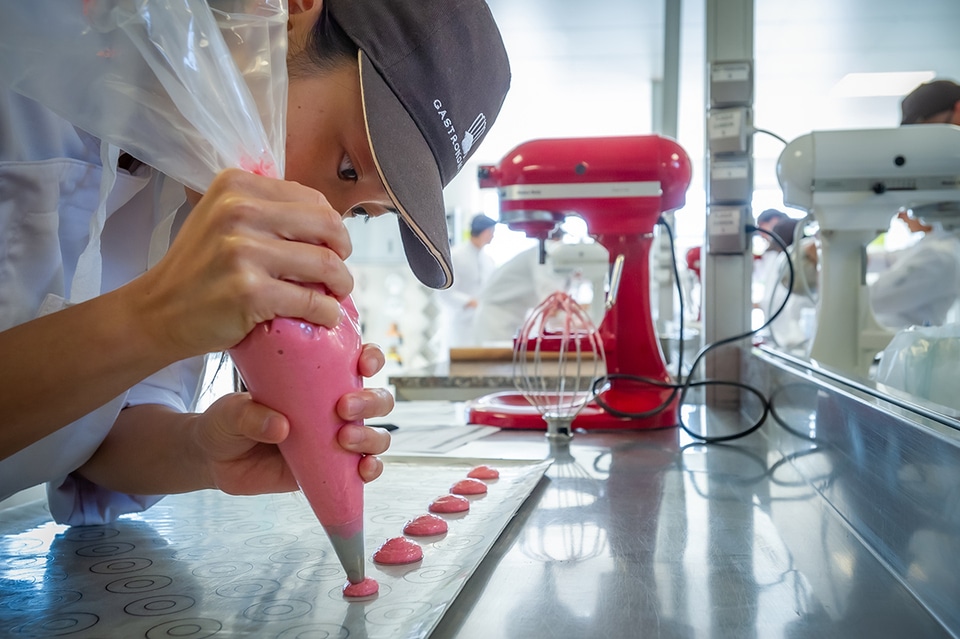
1. Gastronomicom International Culinary Academy
French cooking and pastry in a Mediterranean setting
If your dream of studying French cuisine includes Mediterranean sunshine, beautiful beaches, colorful local markets, and a relaxed Southern French lifestyle, Gastronomicom International Culinary Academy is an especially appealing choice.
Located in the South of France, the school offers international students the opportunity to immerse themselves in French culinary traditions while enjoying one of the country’s most attractive regions. Beyond the classroom, students can explore local food markets, discover regional specialties, and experience the Mediterranean way of life. It’s an inviting setting in which to learn, particularly for those planning to spend several months or even a full year in France.
Another major advantage is that cooking and pastry classes are taught in English, so students don’t need to speak French before enrolling. Courses range from short, two-month programs in cuisine or pastry to longer programs that combine culinary training, French lessons, and professional internships.
The seven-month program includes 12 weeks of cooking or pastry classes and French lessons, followed by a four-month internship. Students looking for more comprehensive training can choose the one-year program, which covers both cooking and pastry, with 24 weeks of classes followed by 24 weeks of professional experience.
The curriculum covers everything from classic French starters, fish, meat, and sauces to artisan breads, viennoiserie, cakes, plated desserts, and chocolate. The one-year program is particularly attractive for students who want to develop skills in both savory cooking and pastry before deciding which direction to pursue professionally.
Student feedback is another encouraging reason to consider Gastronomicom. The school reports consistently high satisfaction levels among its international students. According to its published figures, 92.6% of international students earned their training certificates in 2024–25. More than 90% of respondents to its satisfaction survey also reported being satisfied or highly satisfied with several aspects of their experience, including the instructors’ professional expertise and availability, course duration, and administrative organization.
These are school-reported figures rather than independently verified results, but they offer a positive indication of the student experience, particularly for international applicants considering studying abroad for the first time.
Affordability adds to the appeal. Gastronomicom is among the more accessible private culinary schools in this guide, with substantially lower advertised fees than some of the intensive programs and diplomas offered by FERRANDI and Le Cordon Bleu. The programs differ in duration, teaching hours, and qualifications, so direct price comparisons have their limitations. Nevertheless, for students seeking English-language culinary training, professional experience, and the chance to enjoy life in Southern France, Gastronomicom offers an attractive combination.
Published fees: A two-month cooking or pastry course costs €5,100, while combining both subjects costs €6,900. The seven-month program with French lessons and an internship is €9,800, and the one-year cooking, pastry, French, and internship program is €19,000. These prices include enrollment fees; accommodation is charged separately.
2. FERRANDI Paris
Intensive French culinary training with a notable alumni record
For aspiring chefs drawn to Paris, FERRANDI offers a compelling combination of practical training and an established place in French culinary education. Its reputation also has a distinctive connection to our own research: 22 of the 181 France-based Michelin-starred chefs studied by Chef’s Pencil had attended FERRANDI, more than any other institution in the sample. That finding reflects alumni backgrounds and not the likelihood that any particular student will achieve Michelin recognition.
For English-speaking applicants, the Intensive Professional Program in French Cuisine is a particularly relevant option. It runs for 16 weeks, with an optional three-month internship, and is taught in English. Guest chefs may demonstrate in French with translation, and course materials are provided in English.
The curriculum combines foundational cooking techniques with French regional cuisine, restaurant service, wine appreciation, and professional French. Students also prepare meals for customers in the school’s training restaurant, connecting classroom instruction with the demands of service.
There is an important language consideration, however. FERRANDI does not require French for admission to its intensive programs, but it warns that some internship employers will not accept students who cannot communicate in French. French lessons are included, though the school encourages students to do additional language learning rather than rely on those lessons alone.
Published tuition: The intensive French cuisine program is listed at €24,500, including uniforms, a toolkit, course materials, and excursions. This is the fee for the intensive certificate and not an annual bachelor’s degree fee.
We’d consider FERRANDI particularly relevant for applicants seeking focused professional training in Paris who are also prepared to work on their French before an internship.
3. Institut Lyfe
A culinary degree that combines cooking with management
Lyon offers a different kind of French culinary immersion, from its traditional bouchons to the food stalls of Les Halles de Lyon Paul Bocuse. Just outside the city, in Écully, Institut Lyfe (formerly Institut Paul Bocuse) offers a route for students who want to develop both their cooking skills and their ability to manage a restaurant or culinary business.
Its three-year Bachelor in International Culinary Arts Management includes a fully English-taught track. Unlike a short professional course, it combines culinary development with broader study in areas such as marketing, human resources, cost control, and entrepreneurship.
That does not mean leaving practical cooking behind. According to the school, around half of the course is devoted to professional experience in its training restaurants and practical work in kitchens and culinary laboratories. Each year also includes a placement lasting at least 12 weeks.
The distinction matters when comparing schools: this is a three-year higher-education qualification, carrying 180 ECTS credits, rather than an intensive school-issued culinary certificate. International applicants with an equivalent school-leaving qualification can apply directly to the institution.
Published tuition: the tuition costs €13,905 per year for international students in 2026 for this program, plus a one-time €2000 registration fee and a €105/year student and campus contribution tax. Living expenses need to be budgeted separately.
Institut Lyfe is worth considering when the ambition extends beyond becoming a technically accomplished cook to leading teams, developing a food concept, or eventually running a business.
4. Le Cordon Bleu Paris
Classical French cuisine and pastry with English translation
Le Cordon Bleu is one of the best-known names in culinary education, with a Paris history dating to 1895. For students attracted to a structured progression through classical French cooking or pâtisserie, its Paris campus offers several professional diploma options.
The language arrangement deserves particular attention: Le Cordon Bleu Paris is not simply an English-taught school. For its Cuisine Diploma, theoretical classes and demonstrations are taught in French and consecutively translated into English. Applicants can meet the published language requirement through B2-level English or A2-level French.
The Diplôme de Cuisine progresses through Basic, Intermediate, and Superior levels. It takes nine months on the standard schedule or six months on the intensive schedule. Students interested in both savory cooking and pastry can consider the Grand Diplôme®, which combines the Cuisine and Pâtisserie diplomas.
An internship is not automatically part of the standard Cuisine Diploma. The separate Cuisine Diploma with Internship Pathway extends the training to 13–18 months and includes additional professional application and workplace experience. Students must achieve A2 French by the end of the professional application period to proceed with the internship.
Published tuition: The school’s dated 2027 listings show €35,500 for the Cuisine Diploma, including the application fee, learning materials, equipment, and uniform. The separate internship pathway is listed at €38,500. Living expenses need to be budgeted separately.
For prospective students, the key decision is therefore not just whether to choose Le Cordon Bleu, but which diploma and practical-experience route best match their plans.
5. École Ducasse
Locations: Meudon, near Paris, and Yssingeaux, France
Training focus: Culinary and pastry arts, from intensive courses to bachelor’s programs
Few names in French gastronomy carry as much prestige as Alain Ducasse, the legendary Michelin-starred chef and restaurateur. At École Ducasse, students have the opportunity to learn culinary techniques inspired by his philosophy, with a strong emphasis on precision, creativity, and respect for quality ingredients. And with a choice of campuses near Paris and in the French countryside, there’s plenty to discover beyond the classroom, too.
The school’s flagship Paris Campus, located in Meudon just outside the French capital, is an exciting place to study professional cooking. With Paris’s incredible restaurants, pâtisseries, food markets, and culinary traditions within easy reach, students can immerse themselves in French food culture while developing their skills. For those more interested in pastry, chocolate, and confectionery, the École Nationale Supérieure de Pâtisserie in Yssingeaux offers specialized training in a quieter setting in the beautiful Auvergne region.
École Ducasse caters to students at different stages of their careers, from beginners and career-changers to aspiring chefs looking for a more extensive education. Programs range from short, intensive Essentials courses and professional diplomas to three-year bachelor’s degrees in culinary and pastry arts. The longer programs combine hands-on kitchen training with business and management skills, as well as professional internships.
Whether your dream is to work in a Michelin-starred kitchen, become a pastry chef, or eventually open your own restaurant, École Ducasse offers several routes into the profession. And the opportunity to develop your skills in the country that helped shape modern fine dining is certainly part of the appeal.
6. École Ritz Escoffier
French cuisine and pastry at the Ritz Paris
For aspiring chefs drawn to the world of luxury hospitality and deep pockets, studying at the École Ritz Escoffier offers a particularly memorable setting. Located at the Ritz Paris on Place Vendôme, the school combines classical French cooking and pastry training with an introduction to the precision and organization expected in high-end professional kitchens.
Its Diploma in Culinary Arts comprises 28 weeks and 840 hours of training, progressing through six levels: initiation, intermediate, and advanced courses in both cuisine and pastry. Designed to welcome beginners, aspiring professionals, and career-changers, the program develops practical skills alongside production management, kitchen organization, and an understanding of restaurant operations.
For English-speaking students, the key distinction is that teaching takes place in French with consecutive English translation, rather than entirely in English. The school’s three teaching spaces each accommodate up to eight participants, creating a small-group setting for practical work.
The curriculum extends beyond kitchen exercises through market visits with chefs, meetings with artisans, and presentations by industry professionals. Each level includes practical assessments, and students completing the advanced stages develop two signature creations, presented at a celebratory buffet at the Ritz Paris.
Internship opportunities are conditional, not guaranteed. Depending on availability and the student’s level, an internship of up to six months may be possible, potentially including a placement of less than two months in the Ritz Paris kitchens. Applicants should confirm the arrangements directly with the school.
Published tuition: €42,500, including VAT, for the complete 28-week diploma. Individual cuisine and pastry levels are also listed separately. For students seeking intensive training in both disciplines within a luxury-hotel setting, École Ritz Escoffier is a distinctive option, but one that requires careful financial planning.
7. École Lenôtre
Intensive culinary training near Paris
For students drawn to French gastronomy, École Lenôtre offers a setting close to the ingredients and suppliers that keep professional kitchens running. Founded by Gaston Lenôtre, the school is based in Rungis, near Paris and its major wholesale food market, with modern facilities dedicated to culinary training.
Its Cuisine Program combines 21 weeks of intensive training with a four- to nine-week work placement in Lenôtre workshops or at partner sites. Three progressive stages take students from foundational recipes and techniques to more elaborate French cooking and contemporary, high-end dishes. Classes accommodate a maximum of 12 participants.
Practice and repetition are central to the teaching approach. Alongside cooking, students explore recipe development, menu planning, food safety, purchasing, and cost control. For career-changers, that combination offers an introduction to both preparing dishes and organizing production in a professional kitchen.
The school advertises instruction in both French and English, but English-speaking applicants should confirm the arrangements for practical classes and assessments, along with any French-language expectations during the work placement.
Tuition: A fee is not published on the program page. Request a current quotation and a breakdown of what it includes before comparing costs with other schools.
Related: Best Culinary Schools in Europe
Related: Is Culinary School Worth it?
