15 Best Culinary Schools in Europe for Aspiring Chefs
Choosing a culinary school is about both what you want to learn and where you hope that education will take you. For international students, studying in France, Italy, Spain, or Switzerland can be an opportunity to immerse themselves in local food culture, explore regional ingredients, and learn culinary traditions firsthand. For many, the appeal also lies in earning a prestigious degree or diploma and gaining access to internships and industry connections that could help open doors at Michelin-starred restaurants and luxury hotels.
Those ambitions look different for everyone. A high school graduate seeking a degree, a career-changer looking for intensive practical training, and a working chef hoping to specialize in pastry will need different programs. The right choice should balance the school’s reputation with the substance of its training, the professional experience it offers, and the cuisine you want to explore. Before comparing institutions, consider your budget, how much time you can commit, and what kind of kitchen (or food business) you hope to work in afterward.
The following guide brings together some of the best culinary schools, colleges, and training institutions across Europe. It is not a ranking: an intensive cooking diploma and a four-year gastronomy degree serve different purposes. The entries are grouped geographically, with an emphasis on what makes each option worth investigating.
France
Few countries inspire aspiring chefs quite like France, the birthplace of haute cuisine and home to culinary legends such as Paul Bocuse and Alain Ducasse. From exquisite pâtisseries and buttery croissants to Michelin-starred restaurants, French food culture is celebrated around the world. And what better place to master classical cooking techniques, explore modern gastronomy, or learn the art of French pastry than in France itself?
Gastronomicom International Culinary Academy
Location: Agde, southern France
Training focus: French cooking and pastry, English-language instruction, and French language study
Cost: From €5,100 for the 2-month program to €19,000 for the 1-year cooking &pastry program (incl. internship)
Imagine learning the secrets of French cuisine just a short distance from the Mediterranean, where sunny days, beautiful beaches, lively markets, and fantastic regional food are all part of the experience. That’s part of the appeal of Gastronomicom International Culinary Academy, located in Agde in the south of France. It’s a wonderful opportunity to immerse yourself in the French way of life while learning to cook like a professional.
And here’s some good news for international students: you don’t need to speak French to enroll. Cooking and pastry classes are taught in English, while French language lessons help students settle into local life and prepare for internships in French restaurants. The school welcomes both beginners and experienced cooks, with fully equipped professional kitchens dedicated to culinary and pastry training.
Programs range from short, intensive courses to seven-month and one-year options that include restaurant internships. The longer programs combine hands-on cooking and pastry training with French lessons and professional experience, giving students the chance to put their new skills to work in a real restaurant kitchen.
For those dreaming of the full Mediterranean experience, Gastronomicom also offers optional accommodation through partner residences in nearby Cap d’Agde. It’s an appealing choice if you want to master French culinary techniques, gain practical experience, and enjoy a taste of life in southern France along the way.
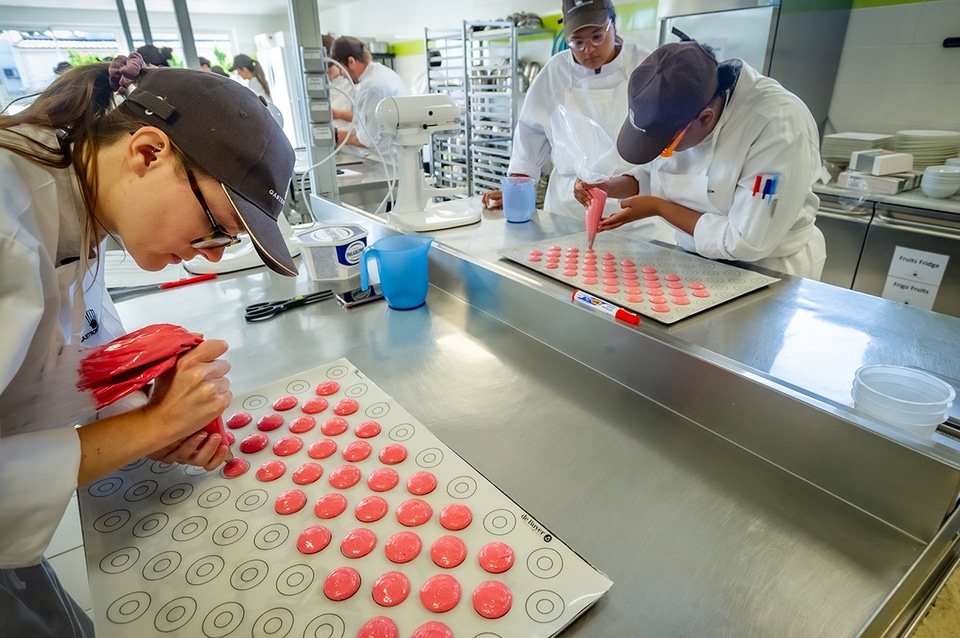
FERRANDI Paris
Location: Paris and regional campuses across France
Training focus: French cuisine, pastry, bread baking, culinary entrepreneurship, and hospitality
Cost: €15,000/year for the 3-year B.A. in Culinary Arts and Entrepreneurship
If you’ve dreamed of studying French cuisine in Paris, FERRANDI offers a particularly exciting opportunity. After all, Paris has the second-highest number of Michelin-starred restaurants in the world, behind only Tokyo. Between its legendary restaurants, neighborhood bistros, beautiful pâtisseries, and bustling food markets, the city is practically a culinary classroom in itself. And at FERRANDI, you get to study right in the heart of it.
The school’s reputation is backed by an impressive track record. In Chef’s Pencil’s research into the educational backgrounds of 181 Michelin-starred chefs working in France, 22 had attended FERRANDI, more than any other culinary school in our study. For aspiring chefs hoping to work in fine dining, that’s an encouraging finding, even if attending a prestigious school is no guarantee of landing a job in a Michelin-starred kitchen.
FERRANDI offers everything from short to intensive professional courses and bachelor’s degrees, covering French cooking, pastry, bread baking, and culinary entrepreneurship. International students can also choose English-taught programs, including a 16-week intensive course in French cuisine with an optional three-month internship. You don’t need to speak French to enroll in that particular program, although learning the language will certainly make life in Paris easier and open up more opportunities for professional experience.
And Paris isn’t the only option. FERRANDI also has campuses in other parts of France, including Bordeaux, Dijon, Rennes, and Saint-Gratien. Each location offers its own opportunities to explore French food culture, although programs vary by campus. Whether you’re looking for an intensive introduction to French culinary techniques or a longer academic program, FERRANDI is certainly a school worth considering.
Institut Lyfe (Formerly Institut Paul Bocuse)
Location: Écully, near Lyon, France
Training focus: Culinary arts and pastry, restaurant management, and entrepreneurship
Cost: €13,905/year for the 3-year B.A. in Culinary Arts and Entrepreneurship
If there’s one French city that takes its food seriously, it’s Lyon. Often called the gastronomic capital of France, it’s famous for its traditional bouchons (small restaurants serving hearty local specialties), wonderful food markets, and Michelin-starred restaurants. It’s also the city most closely associated with legendary chef Paul Bocuse. For aspiring chefs, studying here means being surrounded by an extraordinary food culture, with plenty to discover beyond the classroom, from the stalls of Les Halles de Lyon Paul Bocuse to the city’s countless restaurants.
Just outside Lyon, in Écully, you’ll find Institut Lyfe, formerly known as Institut Paul Bocuse until its rebranding in 2023. The school builds on the culinary legacy of its famous co-founder while taking a modern approach to education. The idea isn’t simply to teach students how to cook exceptionally well, but also how to manage a kitchen, lead a team, and potentially run their own restaurant.
Its three-year Bachelor in International Culinary Arts Management combines hands-on culinary training with food science, marketing, accounting, human resources, and restaurant concept development. There’s a fully English-taught option, making it particularly attractive to international students. And practical experience is a major part of the curriculum: according to the school, around half of the program is devoted to hands-on work in its training restaurants and culinary facilities, where students have the opportunity to prepare food for real guests.
It’s an appealing choice for students who dream of becoming head chefs, opening their own restaurants, or pursuing leadership roles in the hospitality industry. And with Lyon’s fantastic dining scene on your doorstep, there are plenty of opportunities to learn about French cuisine outside school hours, too.
Le Cordon Bleu — Paris, France & London, United Kingdom
Locations: Paris, France, and London, United Kingdom
Training focus: Classical French cuisine, pastry, culinary management, and professional internships
Cost: €35,500 for the 9-month Cuisine Diploma certificate (Paris HQ)
Few names in culinary education are as recognizable as Le Cordon Bleu. Founded in Paris in 1895, the institution has trained generations of chefs in classical French cooking and pâtisserie, and its influence extends far beyond France. In fact, Le Cordon Bleu stood out in two recent Chef’s Pencil studies of Michelin-starred chefs: 8.3% of the 278 chefs analyzed in the United States had attended one of its schools, making it the second-most represented institution in our study. In the UK, three chefs in our sample had trained at Le Cordon Bleu, including international campuses.
For aspiring chefs, Le Cordon Bleu offers the opportunity to master French culinary techniques in Paris or London. The London campus is particularly appealing to international students who want to study in English while experiencing one of Europe’s most diverse restaurant scenes. That’s what attracted Chef Bomee Ki, Executive Pastry Chef and co-founder of Michelin-starred Sollip. Originally from South Korea, she wanted to study French pâtisserie but didn’t speak French. As she told Chef’s Pencil:
“It was there that I was first introduced not just to pastry, but to the whole world of fine dining.”
Le Cordon Bleu offers professional programs ranging from the Grand Diplôme®, combining French cuisine and pastry, to specialized pastry diplomas. In London, the Diplôme de Pâtisserie takes nine months, or six months on an intensive schedule. Paris offers French-language instruction with English translation, while London teaches in English. Some programs also offer culinary management training and internship opportunities.
The main drawback is the cost. For 2027, tuition at the London campus is approximately £24,200 for the standard pastry diploma and £49,500 for the nine-month Grand Diplôme, excluding living expenses. It’s a substantial investment, so prospective students should carefully weigh the school’s reputation and professional opportunities against the cost and their long-term career goals.
United Kingdom
Chef’s Pencil’s UK research highlights the importance of vocational education alongside private culinary schools. Capital City College appeared in seven chefs’ educational backgrounds, Bournemouth and Poole College in five, and University College Birmingham in two. Together with Le Cordon Bleu, these were the most represented institutions in the sample. The Royal Academy of Culinary Arts also identifies the three British colleges among the institutions delivering its chef-apprenticeship pathways.
For applicants, this is a reminder to compare college-based and work-based training with private diplomas—not assume that the most expensive route is necessarily the most suitable.
Capital City College (Formerly Westminster Kingsway College), Westminster
Location: London, United Kingdom
Training focus: Professional cookery, pastry, hospitality, and vocational training
Cost: Depends on age and residency status
What better place to start a culinary career than London? The British capital has one of the world’s most exciting and diverse restaurant scenes, with everything from traditional British pubs and neighborhood restaurants to innovative international concepts and some of the finest dining establishments in the world. And the scene continues to evolve. In 2026 alone, 11 London restaurants received their first or an additional Michelin star, bringing the city’s total to 84 Michelin-starred establishments. For aspiring chefs, it’s an exciting place to study, explore different cuisines, and experience a thriving restaurant culture firsthand.
Right in the heart of the city, Capital City College’s Westminster campus, formerly known as Westminster Kingsway College, has a culinary training tradition stretching back more than a century. Its School of Culinary Arts and Hospitality combines classroom instruction with hands-on experience at The Vincent Rooms, where students prepare and serve food to real customers.
The college has an impressive list of alumni, including celebrity chefs Jamie Oliver and Ainsley Harriott, as well as winners of MasterChef: The Professionals and Great British Menu. Its reputation is also reflected in Chef’s Pencil’s recent research into the educational backgrounds of 150 Michelin-starred chefs working in the UK. Seven had trained at Capital City College, more than at any other culinary school in our study.
Unlike some of Europe’s expensive private culinary academies, Capital City College offers vocational qualifications and practical training pathways, including introductory cookery courses, advanced professional chef diplomas, and apprenticeship opportunities. It’s an attractive option for students who want to build solid kitchen skills and gain real-world experience before moving into professional restaurant kitchens.
For international students, London’s vibrant food scene is a major attraction in itself, although it’s worth checking course eligibility, tuition fees, and visa requirements carefully. Some programs are designed primarily for younger UK students, while others may be more suitable for adults looking to change careers or develop their culinary skills.
University College Birmingham
Location: Birmingham, United Kingdom
Training focus: Professional chef training, culinary management, and food-related degrees
Cost: Ranges between £1286 and £5421 for international students for the 1-year professional cookery diploma
University College Birmingham’s Birmingham College of Food offers routes ranging from professional chef training to culinary arts management. That breadth makes it worth considering for students who want to develop practical skills while keeping options open in management, teaching, or food development.
Its Culinary Arts Management degree combines culinary study with business learning and a substantial professional placement. The published BA pathway runs over four years, including a placement year, with opportunities in the UK or overseas. Students also have access to professional kitchens, a training restaurant, and food-development facilities.
For applicants comparing qualifications, the distinction between a professional cookery course, a foundation degree, and a full bachelor’s degree matters. Start with the intended career outcome and existing qualifications, then identify the appropriate entry point.
Italy
Italian cuisine consistently ranks among the world’s most popular, and its chefs are among the most celebrated in the culinary world. From the simplicity of a perfectly made pizza or pasta dish to the creativity of Michelin-starred dining, Italy has an extraordinary food culture that’s admired and enjoyed around the globe. And what better place to learn the secrets of Italian cooking than in Italy itself?
For international students, studying here is about much more than mastering recipes and techniques. Imagine exploring local food markets, discovering regional cheeses and cured meats, learning to make fresh pasta from scratch, and understanding why Italian cooking places such importance on quality ingredients. Whether you’re studying near Parma, in the heart of Florence, or in northern Italy’s Lombardy region, you’ll have the opportunity to immerse yourself in local culinary traditions while developing the skills and professional connections that could help launch your career.
ALMA: The School of Italian Culinary Arts
Location: Colorno, near Parma, Italy
Training focus: Italian cuisine, regional ingredients, pastry, and professional restaurant experience
Cost: €30,200 for the 11.5 month Italian Culinary Program
Imagine studying Italian cuisine in the heart of Italy’s famous Food Valley, surrounded by producers of Parmigiano Reggiano, Prosciutto di Parma, and other exceptional regional ingredients. That’s the setting for ALMA, housed in the beautiful Ducal Palace of Colorno, just outside Parma. It’s hard to imagine a more fitting place to discover the traditions and flavors of Italian cooking.
ALMA’s international programs combine hands-on culinary training with food history, wine studies, and visits to local producers. Its English-taught Italian Culinary Program progresses from fundamental techniques to advanced cooking, with a mandatory restaurant internship during the advanced stage.
The school also offers international programs in pastry and pasta making. And with Parma and the wider Emilia-Romagna region on your doorstep, there’s plenty to explore beyond the classroom, making ALMA an exciting choice for anyone passionate about Italian cuisine.
Apicius International School of Hospitality
Location: Florence, Italy
Training focus: Culinary arts, baking and pastry, food and wine, and hospitality
Cost: Between €16,775/year and €20,900/year for the 2-year programs
Few cities offer a more beautiful setting for studying Italian food than Florence. Between its Renaissance architecture, lively markets, traditional trattorias, and wonderful Tuscan cuisine, the city is a fantastic place to spend a few months (or even a few years) learning about food. Apicius International School of Hospitality makes the most of this setting, combining culinary and hospitality education with opportunities to experience life in one of Italy’s most celebrated cultural destinations.
One of the most interesting things about Apicius is that students don’t have to wait until graduation to experience working with real customers. The school operates Ganzo, a restaurant in Florence’s Sant’Ambrogio neighborhood, where students put their culinary and hospitality skills into practice. There’s also Fedora, a pastry shop where baking and pastry students help create products for customers, gaining experience in everything from production and presentation to food costs and service.
Apicius offers a variety of culinary, baking, food and wine, and hospitality programs, catering to students with different interests and career ambitions. Its teaching approach connects classroom learning with practical experience and the local community, giving international students the chance to understand Italian food culture beyond recipes and textbooks.
And, of course, there’s Florence itself. Studying here means having access to Tuscan food markets, regional wines, traditional bakeries, and countless opportunities to discover Italian cuisine firsthand. For students looking to combine a culinary education with an unforgettable experience abroad, Apicius has plenty of appeal.
CAST: Italian Institute of Culinary Arts & Hospitality
Location: Brescia, Italy
Training focus: Italian culinary and pastry skills, specialist training, and hospitality management
Cost: Between €8.925/year and €12,750/year for the 3-year B.A. in Culinary Arts
Located in Brescia, in northern Italy’s Lombardy region, CAST Italian Institute of Culinary Arts & Hospitality offers a chance to develop professional culinary skills while discovering a region known for its wonderful food and wine. With beautiful Lake Garda nearby, the vineyards of Franciacorta, and easy access to other northern Italian cities, Brescia is an appealing base for international students who want to experience Italian life beyond the classroom.
Formerly known as CAST Alimenti, the school has a strong focus on practical culinary and pastry training, offering programs for aspiring chefs, career-changers, and professionals looking to sharpen their skills. Its Advanced Programs in Culinary Arts and Pastry Arts emphasize hands-on learning, technical precision, and the demands of working in a professional kitchen. Some programs welcome students without previous industry experience, making CAST an option for those taking their first serious steps toward a culinary career.
For students interested in the business side of hospitality, CAST also offers a three-year Bachelor in Culinary Arts & Hospitality Management, taught in English. The program combines culinary techniques with food science, pastry, baking, hospitality management, and business strategy, providing a broader foundation for those who aspire to lead kitchens or eventually run their own businesses.
One important detail for international applicants is that teaching languages vary by course. The bachelor’s program is advertised in English, while certain advanced culinary and pastry programs offer English-language intakes. Also, the bachelor qualification is currently listed as subject to validation, so prospective students should confirm its accreditation and awarding arrangements directly with the school before enrolling.
Spain
Few countries have shaped modern gastronomy quite like Spain. From Ferran Adrià’s groundbreaking work at elBulli to the success of El Celler de Can Roca and Barcelona’s Disfrutar, named the world’s best restaurant in 2024, Spanish chefs have been at the forefront of culinary innovation for decades. Today, Spain is one of the world’s most exciting fine-dining destinations, where centuries-old traditions meet bold, creative cooking.
And what a place to live and study! From the bustling tapas bars of Barcelona and Madrid to San Sebastián’s famous pintxos, colorful food markets, and wonderful regional specialties, Spain is a food lover’s paradise. Add beautiful beaches, sunny weather, lively cities, and a relaxed Mediterranean lifestyle, and it’s easy to see why Spain is such an appealing destination for international culinary students.
Basque Culinary Center
Location: Donostia–San Sebastián, Spain
Training focus: Gastronomy, culinary arts, research, business, and innovation
Cost: €11,900/year for the 4-year degree in culinary arts
If you’re serious about food, San Sebastián is a pretty extraordinary place to study. This beautiful coastal city in Spain’s Basque Country is famous for its pintxos bars, outstanding seafood, and remarkable concentration of Michelin-starred restaurants. From casual neighborhood eateries to some of the world’s most celebrated fine-dining establishments, food is a huge part of everyday life here. And with La Concha Beach and the beautiful Basque coastline on your doorstep, it’s a wonderful place to call home while studying.
The Basque Culinary Center, established in 2011, has become a respected institution for aspiring chefs and gastronomy professionals. Its four-year Bachelor’s Degree in Gastronomy and Culinary Arts, offered through Mondragon University, goes well beyond traditional cooking classes. Students learn professional kitchen techniques alongside food science, restaurant management, hospitality, and culinary innovation, gaining a broad understanding of the modern food industry.
Practical experience is a major part of the program, with professional placements beginning in the first year and opportunities to work in restaurants and food businesses in Spain and abroad as students progress. The school also offers master’s degrees and specialized programs for those looking to develop advanced culinary skills, explore food innovation, or pursue entrepreneurial projects.
One important consideration for international students: the bachelor’s degree is taught primarily in Spanish, although some subjects are offered in English. You’ll need a good command of Spanish to make the most of the program. But for those willing to take on the language challenge, studying in one of Europe’s great gastronomic destinations is an exciting opportunity.
GASMA — CEU Cardenal Herrera University
Location: Castellón de la Plana, Spain
Training focus: Gastronomy, culinary management, food science, and business
Cost: €11,980/year for the 4-year B.A. in Culinary Arts
How does studying gastronomy on Spain’s Mediterranean coast sound? Located in Castellón de la Plana, GASMA combines professional culinary education with sunny beaches, a relaxed lifestyle, and a region famous for its rice dishes, fresh seafood, and wonderful local produce.
As the gastronomy campus of CEU Cardenal Herrera University, GASMA offers a four-year Bachelor’s Degree in Gastronomy combining hands-on cooking with food science, creativity, and business management. The curriculum covers everything from culinary techniques and nutrition to marketing, restaurant operations, and entrepreneurship.
Students train in professional kitchens, pastry workshops, a teaching garden, and a training restaurant. The school also collaborates with experienced industry professionals, including Michelin-starred chefs, and offers internships in Spain and abroad.
For international students, GASMA offers an English-taught first-year track, along with Spanish lessons to prepare for later studies. Since Spanish becomes increasingly important throughout the degree, applicants should check the language requirements carefully.
GASMA is an appealing choice for aspiring chefs who want to combine culinary creativity with the skills to manage a restaurant or launch their own food business. And the Mediterranean setting is a wonderful bonus!
Culinary Institute of Barcelona
Location: Barcelona, Spain
Training focus: Professional cooking, creativity, specialist techniques, and kitchen leadership
Cost: €29,282 for the 14-month Haute Cuisine certificate
Barcelona has long been a playground for creative chefs, with its traditional Catalan cuisine, lively food markets, innovative restaurants, and vibrant international atmosphere. From exploring La Boqueria to discovering inventive tasting menus, students will find plenty of culinary inspiration beyond the classroom, not to mention the city’s beautiful architecture and beaches.
The Culinary Institute of Barcelona (CIB) embraces this creative spirit, encouraging students to experiment, challenge conventional techniques, and develop their own cooking style. Its programs combine hands-on training with culinary technology, innovation, and the practical skills needed in professional kitchens.
The school’s Haute Cuisine Chef Diploma offers intensive 11- and 14-month pathways for aspiring chefs who want professional training without committing to a four-year degree. CIB also offers specialized courses in pastry, chocolate, advanced cooking techniques, and healthy cuisine, alongside programs in kitchen leadership and restaurant management.
With an international student community, CIB provides instruction in Spanish and English, supported by real-time translation, bilingual materials, and optional Spanish lessons.
For students passionate about creativity and modern gastronomy, CIB offers an exciting opportunity to develop their skills in one of Europe’s most dynamic food cities.
Switzerland
Switzerland has a world-class reputation for hospitality education, luxury hotels, and exceptional service. Its culinary schools build on this tradition, combining hands-on cooking with restaurant management, entrepreneurship, and professional internships. With French, Italian, and German influences shaping its food culture, Switzerland also offers a fascinating mix of culinary traditions.
And what a beautiful place to study! From picturesque Lucerne and Lake Geneva to the spectacular Swiss Alps, students can enjoy stunning landscapes, charming towns, and a multicultural environment. Switzerland’s strong connections to the luxury hospitality industry are another major attraction.
The downside? Switzerland is one of Europe’s most expensive countries to live and study, so tuition and living costs require careful planning. For those who can afford it, however, a Swiss culinary education offers an appealing combination of practical training, international experience, and industry connections.
BHMS
Location: Lucerne, Switzerland
Training focus: Culinary arts, pastry, business skills, and recurring industry placements
Cost: 30,100 CHF per year for 3-year B.A. in Culinary Arts
BHMS structures its culinary education around academic study and professional experience. Its culinary pathway progresses through diploma and higher-diploma stages toward a bachelor’s degree, with six-month study periods followed by internships. The published curriculum moves from foundational food preparation and European cuisine toward more advanced culinary operations and business responsibilities.
Later study includes areas such as menu design, cost management, culinary business analysis, leadership, and product development. BHMS also offers a separate culinary arts and patisserie pathway for students whose interests center on pastry, chocolate, and baking.
This structure is worth comparing with courses that concentrate most teaching into a single intensive period. Before committing, ask for a clear breakdown of classroom time, practical kitchen hours, internship arrangements, and the total costs associated with each stage.
Culinary Arts Academy Switzerland
Locations: Le Bouveret and Brig, Switzerland
Training focus: Culinary and pastry arts with entrepreneurship and restaurant management
Cost: 23,200 CHF for the 1-year Professional Swiss Diploma certificate (total cost of 40,000 CHF when meals, accommodation and other service charges are included).
Culinary Arts Academy Switzerland offers a three-year Bachelor of Arts in Culinary Arts that combines practical training with business study and two industry internships. Its published program places the earlier stages in Le Bouveret and the final bachelor’s stage in Brig.
The curriculum develops from classical cooking and culinary operations into areas including food-cost management, restaurant service, product development, marketing, and business planning. The academy also offers shorter professional Swiss diploma routes and dedicated pastry education.
For prospective restaurateurs, the connection between kitchen skills and business planning may be particularly relevant. Students primarily interested in technical cooking should compare the degree with the shorter diploma options and ask how the practical training differs between them.
Portugal
Portugal has become one of Europe’s most appealing travel destinations, with beautiful beaches, historic cities, sunny weather, and a relaxed lifestyle. But its food is just as exciting! From freshly grilled seafood and bacalhau to hearty regional stews, wonderful wines, and irresistible pastéis de nata, Portuguese cuisine is full of delicious discoveries.
For aspiring chefs, studying in Portugal offers the chance to explore these culinary traditions firsthand while enjoying everything the country has to offer. Another major advantage is affordability: Portugal is generally less expensive than Switzerland, the UK, or France, particularly when it comes to everyday living costs. With culinary and hospitality schools in Lisbon, Porto, and beyond, it’s an attractive destination for international students seeking quality training, great food, and an enjoyable lifestyle without breaking the bank.
Escolas de Hotelaria e Turismo — Turismo de Portugal
Locations: A network of schools across Portugal
Training focus: Practical culinary and hospitality education, including Portuguese cuisine and kitchen management
Cost: €1,500 for the 1-year Culinary Arts certificate
Portugal’s Escolas de Hotelaria e Turismo should be understood as a network of hospitality and tourism schools, rather than one institution operating from a single campus. Turismo de Portugal provides information on the individual schools and their course offerings through a shared platform.
One relevant option is the Culinary Arts technological specialization program. It runs for one year, with two semesters and a curricular internship, combining practical cooking with areas such as kitchen operations, food safety, sustainability, and team coordination. The curriculum includes traditional and regional Portuguese cuisine alongside international cooking.
Course availability and teaching language vary by school. The network lists English-language options at selected locations, including Lisbon, Estoril, and Porto. Applicants should therefore choose a specific campus and intake before comparing admissions requirements, costs, and placement arrangements with other schools.
Is Culinary School Actually Worthwhile?
Chef’s Pencil’s research offers a useful perspective. Across our studies of Michelin-starred chefs, 61% of those in our France-based and U.S.-based samples had attended culinary school or a formal hospitality program, compared with 46% in the UK sample. The studies examined 181 chefs in France, 278 in the United States, and 150 in the United Kingdom. Formal training was a common route, but far from the only one. These findings describe the educational backgrounds of selected successful chefs; they do not establish the likelihood that a culinary-school graduate will achieve similar success or whether a particular course represents good financial value.
Chef Yuu Shimano offered a balanced view when discussing his own education with Chef’s Pencil:
“Attending the Tsuji Culinary Institute, both in Japan and in France, gave me the foundation of classic technique and discipline that still supports my cooking today. … For young chefs, I believe formal training is not the only path, but having a strong foundation—whether in a school or through a structured apprenticeship—is essential.”
— Chef Yuu Shimano, Restaurant Yuu, New York Chef’s Pencil
For prospective students, the question is therefore not simply whether to attend culinary school, but which training route offers the right combination of practical instruction, mentorship, professional experience, and affordability.
How to Choose the Right Culinary School
A recognizable name can help you build an initial shortlist, but the final decision should rest on the program you will actually attend.
Start with the qualification. Ask whether you will receive a school-issued certificate, a professional diploma, a nationally recognized vocational qualification, or a university degree. Request the name of the awarding body and an explanation of what the qualification allows you to do next.
Look closely at practical training. Ask how many hours involve cooking yourself, rather than watching demonstrations or attending lectures. Find out whether students work with paying guests, how practical skills are assessed, and how much individual feedback you can expect.
Examine the placement arrangement. Ask who finds the internship, which conditions students must meet, whether it is paid, and what happens if a placement falls through. A placement opportunity and a placement included in the course are not promises you should assume mean the same thing.
Calculate the complete cost. Request an itemized budget covering tuition, equipment, uniforms, ingredients, examinations, housing, transport, and any expenses during placements. Compare that total with the time you would spend studying and the kind of first job you realistically expect to pursue.
Consider the financial commitment and avoid taking on too much debt. Culinary school can be expensive, particularly at prestigious private institutions, and starting salaries in professional kitchens are often relatively modest, even at Michelin-starred restaurants and luxury hotels. If you need to borrow money to finance your studies, think carefully about how much debt you’ll graduate with and whether you can realistically afford the repayments on an entry-level chef’s salary. Factor in interest, living expenses, and the possibility that it may take several years before your earnings increase substantially. A prestigious diploma may open doors, but it doesn’t guarantee a well-paid job. Scholarships, apprenticeships, and more affordable vocational programs are worth exploring before committing to a large financial investment.
Match the course to your experience. A beginner may need repetition and a broad technical foundation. A working chef may gain more from a focused pastry, management, or specialist-technique program. Ask to see the syllabus rather than choosing solely from a program title.
Verify the language requirements. Confirm the language used for practical classes, written assessments, and placements—not just admissions. Where a course changes language after the first year, make sure the transition is realistic for you.
The strongest choice is not necessarily the longest course or the school with the most famous alumni. It is the training route that gives you a solid foundation, useful professional experience, and a manageable path into the work you want to do.
