
Chef of the Week: Pizzaiolo Fabio Stipulante, Audace Ristorante, NYC

Being named one of the best pizzerias in the United States is a major achievement. Ranking No. 14 in the entire country, as Audace Ristorante did in the 2026 50 Top Pizza USA list, puts the New York restaurant firmly among the elite of America’s rapidly evolving pizza scene.
At the center of that success is pizzaiolo Fabio Stipulante, whose contemporary Neapolitan-style pizzas combine technical precision, long fermentation, and a distinctive high, airy crust with an approach that is both rooted in Italian tradition and open to experimentation.
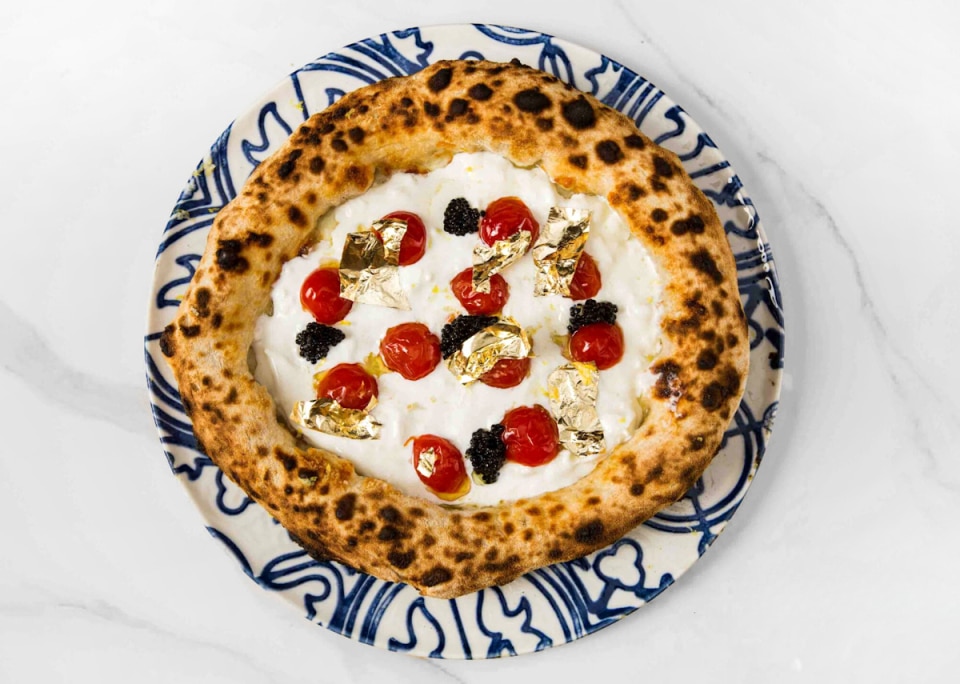
At Audace, that philosophy can take the form of a flawlessly simple Margherita or something far more extravagant, such as the restaurant’s namesake pizza topped with burrata, sun-dried cherry tomatoes, lemon zest, Italian white sturgeon caviar, and 24k gold leaf.
We spoke with Fabio about what it takes to create truly great dough, why time and temperature matter more than most home cooks realize, how New York’s pizza scene now compares with Italy’s, and where he believes modern pizza-making gets innovation right (and where it can go too far).
1. Audace recently ranked No. 14 on the 2026 50 Top Pizza USA list. What did that recognition mean to you, especially in a city with such a competitive pizza scene?
It was a very important recognition and an incredibly emotional moment for us. Reaching No. 14 in the United States, especially in a city as competitive as New York, confirms that our daily work on quality, dough, and identity is moving in the right direction. It makes us proud, but above all, it motivates us to work even harder. We do not see it as a final destination, but as a new starting point.
2. Your pizzas are known for their high, airy crust. What were you trying to achieve when you developed that style, and what makes a great crust in your eyes?
We wanted to create a contemporary pizza that was light, aromatic, and enjoyable down to the very last bite. The crust should be high and airy, but not hollow or purely theatrical. For us, it should be slightly crisp on the outside, soft inside, properly baked, and able to express the aromas developed through fermentation and the natural character of the wheat.
3. Neapolitan pizza is deeply rooted in tradition, but your approach is distinctly contemporary. Where do you draw the line between respecting tradition and giving yourself the freedom to reinterpret it?
Tradition is our starting point. Technique, respect for the dough, ingredient quality, and balance of flavors are essential principles. At the same time, Italian cuisine has always been capable of evolving. We give ourselves freedom when choosing combinations and presentations, but without losing the identity of the pizza. Innovation must have a purpose and, above all, it must taste good.
Italian cuisine has always been capable of evolving. We give ourselves freedom when choosing combinations and presentations, but without losing the identity of the pizza.
4. Dough looks simple on paper — flour, water, salt, yeast — but pizzaioli often spend years perfecting it. What part of dough-making do you think people most underestimate?
The management of time and temperature. Many people focus only on the recipe or hydration percentage, but the same dough can behave very differently depending on the temperature of the flour, water, kitchen environment, and even the season. You have to learn how to observe and feel the dough. It should not have to adapt to our schedule; we must learn to recognize when it is truly ready.
5. Fermentation can completely change the texture and flavor of a pizza. How do you approach fermentation at Audace, and what are you looking for when you decide the dough is ready?
We work with different preferments and maturation periods ranging from 24 to 48 hours, carefully monitoring both time and temperature. We do not rely solely on the clock. We observe the dough’s development, aroma, elasticity, and internal structure. When it is ready, it should feel alive but stable, be easy to stretch, and develop properly in the oven. We are looking for aromatic complexity, lightness, and digestibility.
6. Audace’s namesake pizza combines burrata, sun-dried cherry tomatoes, lemon zest, Italian white sturgeon caviar, and 24k gold leaf. What was the idea behind that combination, and how do you make sure luxury ingredients add something to the flavor rather than simply becoming part of the spectacle?
We wanted to create a pizza that fully represented the name Audace: elegant, surprising, and daring. The burrata provides creaminess, the sun-dried cherry tomatoes add sweetness and intensity, the lemon brings freshness, and the caviar introduces salinity and a delicate marine note. The gold completes the presentation, but it is not the protagonist. A luxury ingredient should improve the flavor and serve a clear purpose. If it is used only to impress, it loses its meaning.
7. With a pizza like the Margherita, there is nowhere for mistakes to hide. Do you think the simplest pizzas are actually the hardest to get right?
Absolutely. There is nowhere to hide with a Margherita. The dough, baking, tomato, mozzarella, basil, and olive oil must all be of the highest quality and perfectly balanced. One small mistake—too much moisture, excessive salt, or just a few extra seconds in the oven—can compromise the result. Simplicity demands great precision.
8. You’ve worked in Italy and now make contemporary Neapolitan-style pizza in New York. Chef’s Pencil research found that New York had more pizzerias represented among the world’s best than any other city, even ahead of Naples and Rome. Do you think New York’s pizza scene has genuinely caught up with—or even surpassed—what you can find in Italy today? What does New York do particularly well?
New York has undoubtedly reached an extraordinary level, but I do not think it is necessary to decide which city has “surpassed” the other. Naples remains the birthplace and possesses a unique pizza culture. New York, however, has a special strength: it welcomes talent and influences from around the world, creating a level of competition that pushes everyone to improve. The public here is curious, open to innovation, and extremely demanding. New York excels in its diversity and its ability to reinterpret pizza while continuing to respect its origins.
New York has a special strength: it welcomes talent and influences from around the world, creating a level of competition that pushes everyone to improve.
9. Pizza has become increasingly creative and technically ambitious in recent years. Is there a trend in modern pizza-making that excites you or one you think has gone too far?
We are excited by the rediscovery of small producers, the appreciation of regional Italian ingredients, and the exploration of new flavor combinations. At the same time, we believe every ingredient needs its own space and a clear reason for being on the pizza. Simplicity is often what allows an exceptional product to shine. In some contemporary interpretations, too many flavors are combined, causing the pizza to lose its identity and balance.
10. Audace may be getting a lot of attention for its pizza, but the menu goes well beyond it. Which main course would you tell guests not to miss? And are there any lesser-known Italian secondi you wish more American diners knew about?
I would recommend our cauliflower with green peppercorn sauce. It is a vegetarian dish that represents the meeting of past and future. We take cauliflower—a simple ingredient often treated as a side dish—and make it the centerpiece of the plate. We serve it with our reinterpretation of green peppercorn sauce, a classic of French cuisine that became especially popular during the second half of the 20th century.
It is our way of recovering a flavor from the past and presenting it in a contemporary, more vegetable-focused, and elegant form. We would like American diners to discover this aspect of modern Italian cooking: a main course does not necessarily need to be built around meat or fish to possess character and depth.

11. For home cooks trying to make better pizza, what is the one mistake you see most often, and what single change would make the biggest difference?
The most common mistake is in the baking. The base is often cooked for too long and becomes hard, while the cheese burns before the tomato has cooked properly. Home ovens do not reach the same temperatures as professional pizza ovens, so the technique must be adapted.
It is essential to preheat a pizza stone—or, even better, a baking steel—for a long time. It can also be helpful to briefly pre-bake the dough with the tomato sauce, adding the cheese only during the final stage. This creates a more even and balanced cooking process for every element.
12. Finally, what are you most excited to explore next at Audace? Are there new dough techniques, ingredients, or pizza styles you’re currently experimenting with?
We are continuing to work on fermentation, biga, and the balance between structure, lightness, and flavor. We are studying new combinations and would also like to introduce traditional regional pizzas that are still relatively unknown in New York, reinterpreting them through our own identity.
At the same time, we want to explore the relationship between contemporary pizza, fine dining, and exceptional Italian ingredients even further. Our goal is to surprise guests, but always with taste, elegance, and consistency.

Pizzaiolo Fabio Stipulante
Audace Ristorante
365 Park Avenue South- New York 10016
