
Chef of the Week: Cal Byerley, Pine Restaurant
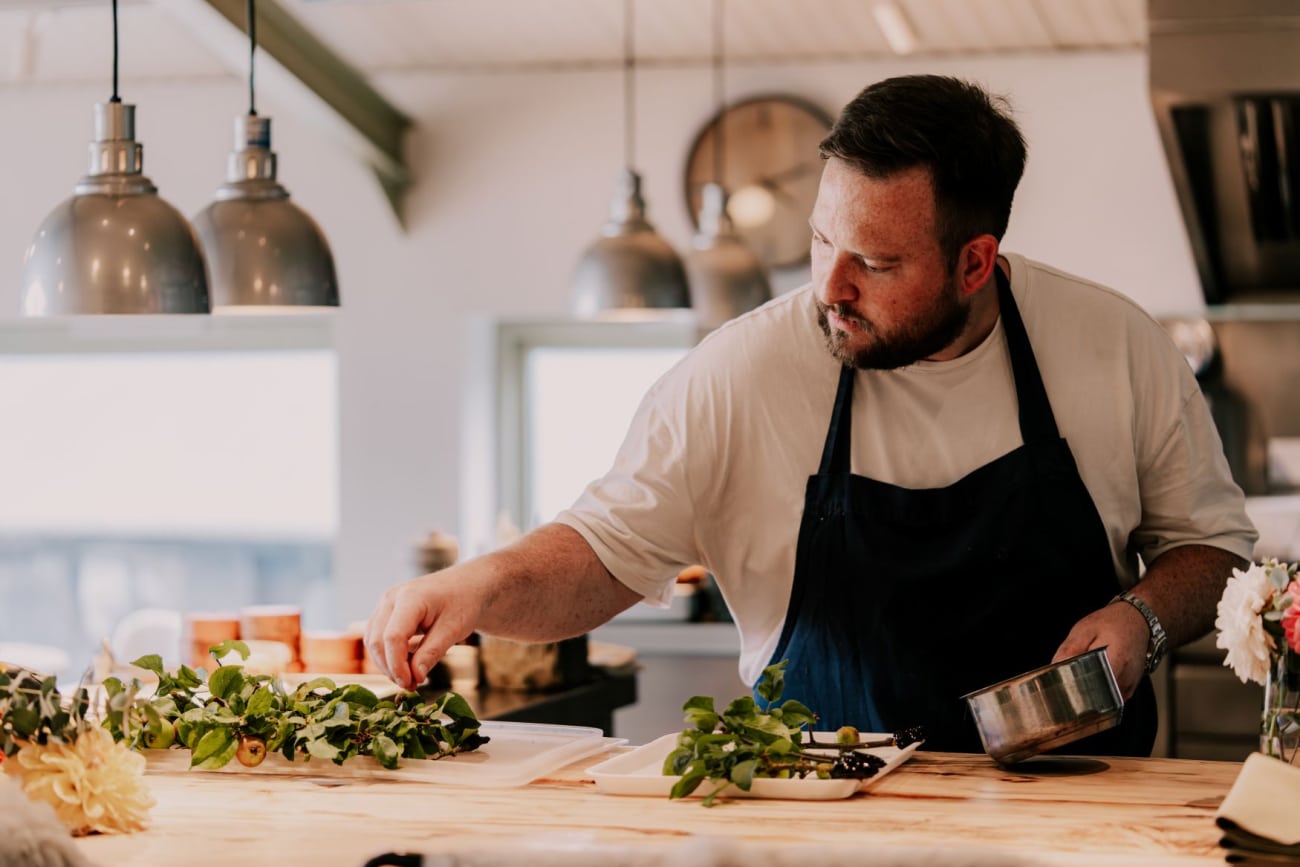
Chef Cal Byerley has never been interested in chasing trends. At Restaurant Pine, the Michelin-starred and Michelin Green Star-awarded restaurant he co-founded with his wife Sian in the heart of Northumberland, he has built a dining experience that is inseparable from its surroundings. Nearly every ingredient comes from within a ten-mile radius, much of it grown, foraged, farmed, or produced by people the team knows personally, while preservation, fermentation, and whole-animal butchery transform local produce into one of England’s most distinctive culinary experiences.
In this week’s Chef of the Week, Byerley reflects on returning home to open Pine, earning both a Michelin Star and a Michelin Green Star just eight months after opening, why sustainability and luxury go hand in hand, and how deep relationships with farmers, foragers, and producers continue to shape every dish that leaves his kitchen.
1. Can you tell us a bit about your culinary journey and what led you to open Restaurant Pine in Northumberland?
I started out in kitchens pretty young, sixteen years old, working at the Robin Hood Inn just down the road from where I grew up. I didn’t really have a grand plan at that point; I just liked being in a kitchen. But that early experience lit something in me, and I ended up spending the next several years working my way through some really serious restaurants, Rogan & Co in Cartmel, then Forest Side in Grasmere, where I worked alongside Kevin Tickle as his head pastry chef. Those years were genuinely formative. I learned an enormous amount about discipline, about precision, about what it means to cook at a really high level.
But if I’m honest, somewhere along the way I started to feel a bit disconnected from the thing that had originally excited me about food. I was executing someone else’s vision brilliantly, I hope, but I’d stopped asking my own questions. And underneath all of that, there was this persistent pull back towards Northumberland. My family have farmed here since 1805. This landscape is in my DNA in a way that’s very hard to explain to someone who didn’t grow up here.
We opened [Restaurant Pine] in 2021, and from the moment we did, I knew this was exactly where I was supposed to be.
Sian felt the same way. We’d both been away for years, both working in great places with great people, but we both found ourselves genuinely pining for home. The first lockdown in 2020 forced our hand in a way, but also gave us the space to actually start planning seriously. We set up a high-end afternoon tea delivery business to keep going, and while we were out making deliveries one day in May 2020, we passed a building at Vallum Farm that Sian had spotted on an old leasing listing. One chance meeting with the landlord later, and everything fell into place. We opened in 2021, and from the moment we did, I knew this was exactly where I was supposed to be.
2. Restaurant Pine earned both a Michelin star and a Michelin Green Star within just eight months of opening. What did that recognition mean to you and your team?
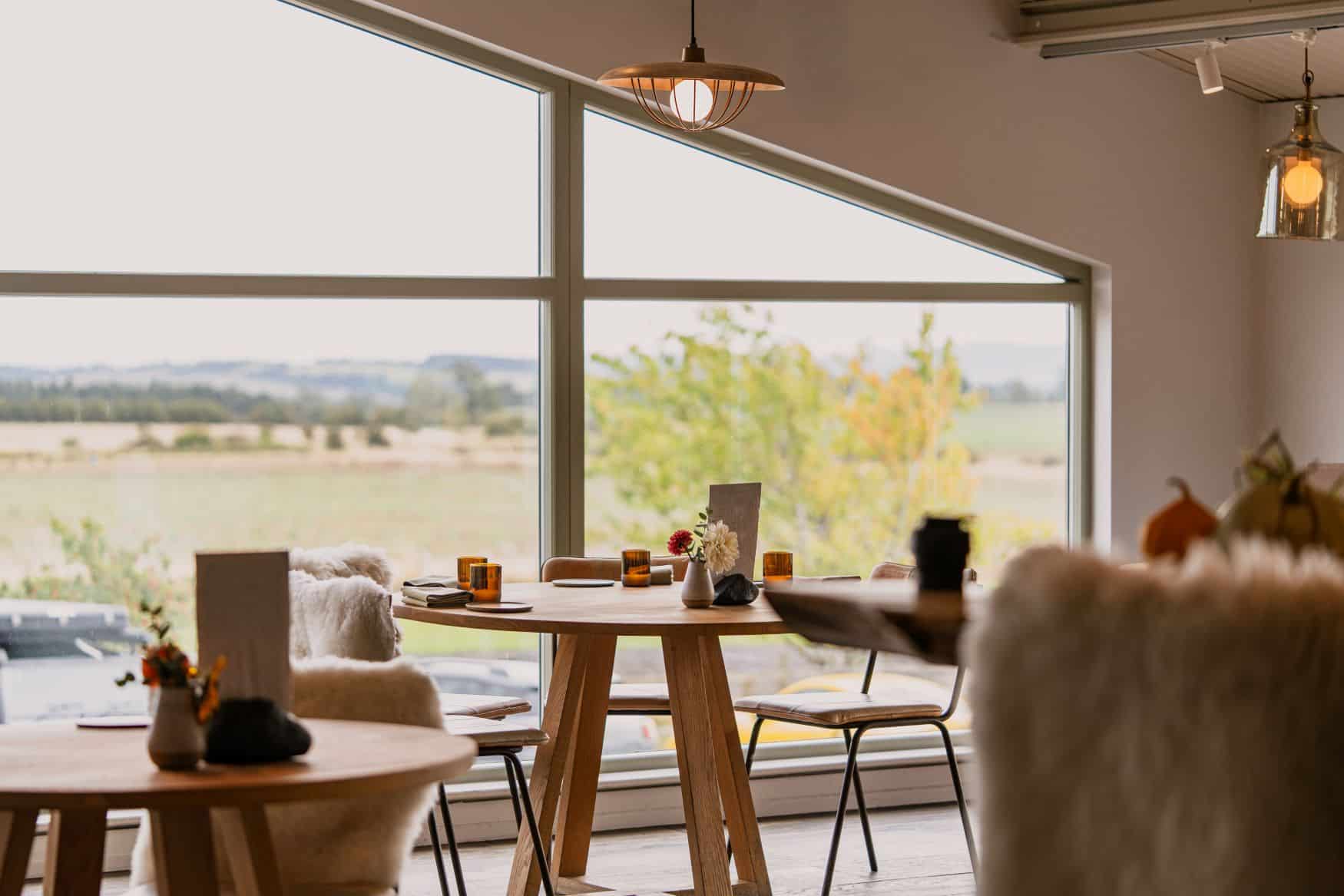
It was extraordinary, genuinely, none of us was really prepared for it, and the feeling and emotions were indescribable at the time. Eight months is such a short space of time; we were still finding our feet in a lot of ways, still learning the rhythms of the restaurant and the seasons in this particular landscape. To receive both stars, and to be the only restaurant in Great Britain and Ireland to receive both in the same year, which wasn’t something we’d dared to imagine happening so quickly.
The morning after the announcement, we were back in the kitchen doing exactly what we’d been doing the day before.
What it meant most, honestly, was validation for the team. Ian, Vanessa, Sian, and everyone who’d taken a chance on this slightly mad idea of opening a serious restaurant in a converted cattle byre in a tiny Northumberland hamlet, they’d all believed in something before there was any evidence the wider world would agree. That recognition said clearly that what we were doing mattered, that the approach had merit, which cooking this way, with this level of commitment to place, provenance, and sustainability, could sit alongside the very best in the country.
But I’ll be straight with you, the morning after the announcement, we were back in the kitchen doing exactly what we’d been doing the day before. The recognition is wonderful, and we’re incredibly proud of it, but it doesn’t change what needs to happen every service. If anything, it raised the stakes in terms of protecting what we’d built rather than letting success alter it.
3. A Michelin Green Star and a traditional Michelin Star can sometimes seem difficult to balance. How do you ensure sustainability enhances rather than compromises refinement and luxury at Pine?
I’d push back slightly on the idea that they create a sort of counterintuitive tension because I think that framing comes from a misunderstanding of what sustainability actually means in practice here. Sustainability at Pine isn’t a constraint we work around to achieve quality; it’s the primary reason the quality is what it is.
Think about it this way. When your flour comes from Gilchester Organics, a few miles away, milled from heritage grains grown in soil that’s been properly cared for, that flour has a character and a depth that commodity flour simply doesn’t have. When your meat comes from Wilde Farm, from animals reared to the highest welfare standards by people you know personally, who farm in a way that respects the land, that produces something categorically different on the plate. The local, the seasonal, the sustainably produced, these things aren’t a compromise on luxury; they are the luxury. The refinement comes from the quality of the raw material, and the quality of the raw material comes directly from how it’s produced and how close it is to us.
The other thing I’d say is that our preservation and fermentation work, the Koji systems, the charcuterie, the way we use every part of an animal, those techniques add layers of flavour and complexity that you genuinely cannot achieve any other way. Constraint, properly embraced, is one of the most powerful creative tools a chef has. Some of the most refined things on our menu exist precisely because we committed to using everything and wasting nothing.
4. Your cuisine is firmly rooted in Northumberland. What makes the region such an inspiring place to cook?
Where do you start? The sheer variety of the landscape, for one thing, includes moorland, dense woodland, rolling agricultural land, and a spectacular coastline, all within a relatively contained area. That diversity translates directly into an extraordinary range of ingredients if you know how to look for them. Foraging here isn’t a supplementary exercise; it’s a serious larder. Mushrooms, berries, coastal plants, pollens, herbs, the woodland and fields around the restaurant provide things you simply cannot source from anywhere else.
But beyond the physical landscape, it’s the people. The farming community here is deeply rooted, multi-generational in many cases. My own family is a good example, over two hundred years on the same land. That kind of long relationship with a particular place produces a quality of knowledge and a quality of produce that you can’t replicate through more commercial means. Working with gamekeepers who know every inch of their ground, with foragers who’ve spent decades learning the seasonal rhythms of this landscape, with the Northumberland Beekeeping Society, with mycologists who are developing genuinely exciting specialist varieties, those relationships are irreplaceable.
And honestly, I think Northumberland’s relative obscurity as a culinary destination has actually been an advantage. The landscape and the agricultural tradition have been left alone in ways that more fashionable regions haven’t. There’s an authenticity and an integrity to what’s produced here that I find endlessly inspiring.
5. Sustainability is central to Pine’s philosophy. How do you approach sourcing ingredients and working with local producers?
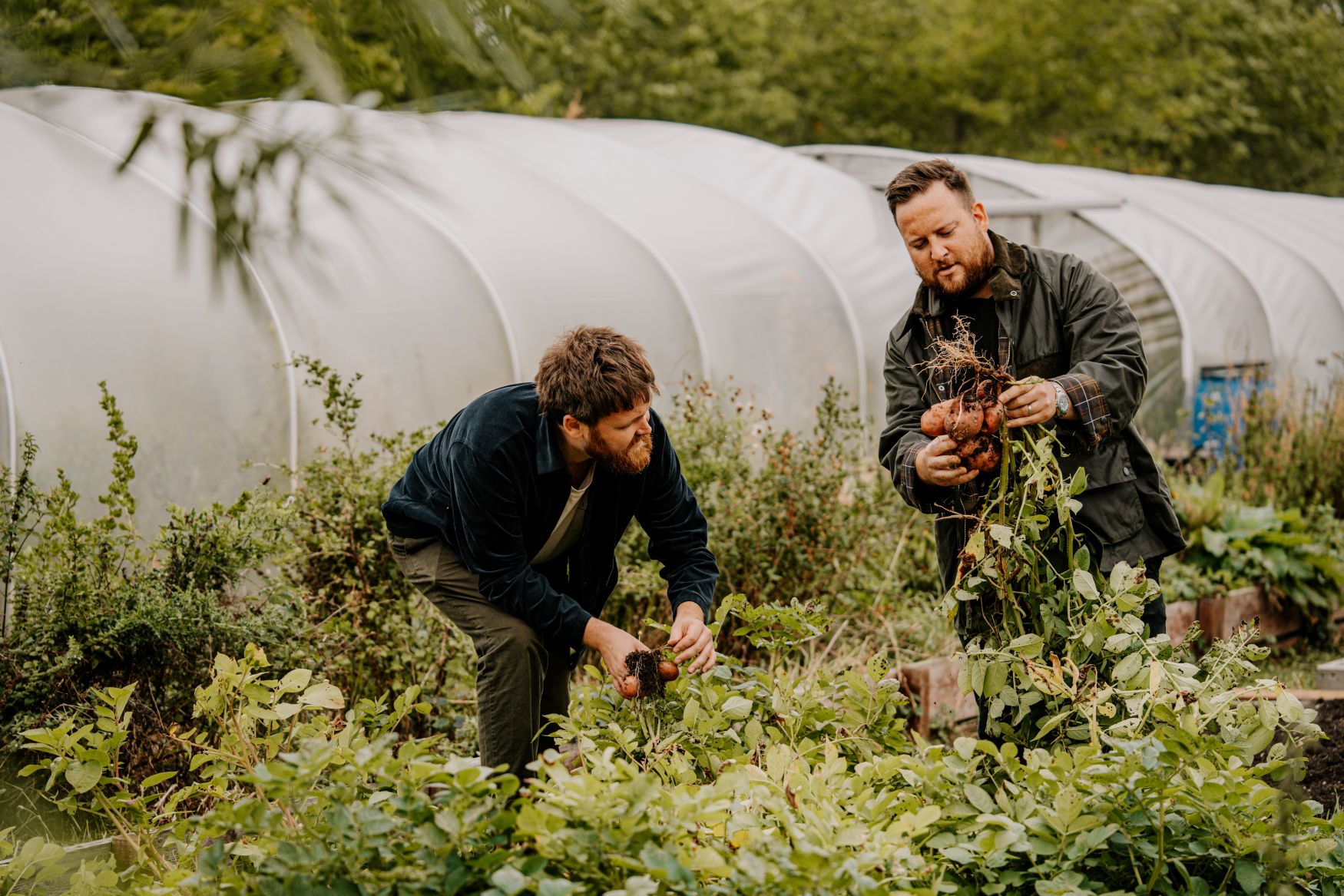
The starting point is always the ten-mile radius. Almost everything we use comes from within ten miles of the restaurant, and that’s not an arbitrary rule; it’s a genuine commitment that shapes every sourcing decision we make. Gilchester for flour, Wilde Farm for meat and poultry, Doddington Dairy for cheese, local gamekeepers for pheasant, guinea fowl, wood pigeon, rabbit and venison, several foragers, the beekeeping society, and our mycologists. These aren’t transactional supplier relationships; they’re genuine partnerships that we’ve invested in over time.
We keep our own chickens, we have our pond, and we maintain our colony of native black bees on site. And we have access to additional growing spaces at my family’s farm nearby for microgreens and seedlings.
We also produce a significant amount ourselves. The kitchen garden right next to the restaurant has growing tunnels, raised beds, an orchard, and a greenhouse. We harvest daily, genuinely daily, because the difference between something picked this morning and something picked three days ago and transported from elsewhere is not subtle. We keep our own chickens, we have our pond, and we maintain our colony of native black bees on site. And we have access to additional growing spaces at my family’s farm nearby for microgreens and seedlings.
On the waste side, we’re very deliberate. We take whole animals where possible; we use every part through a range of preservation and fermentation techniques, and we compost through a Ridan system that can handle bones, fish bones, coffee grounds, and even compostable packaging. We have zero tolerance for plastic in our supply chain. Our heating and electricity come from a biomass system and solar panels on site. None of this is performative; it’s just how we think a kitchen should operate.
6. How would you describe your cooking style to someone visiting Pine for the first time?
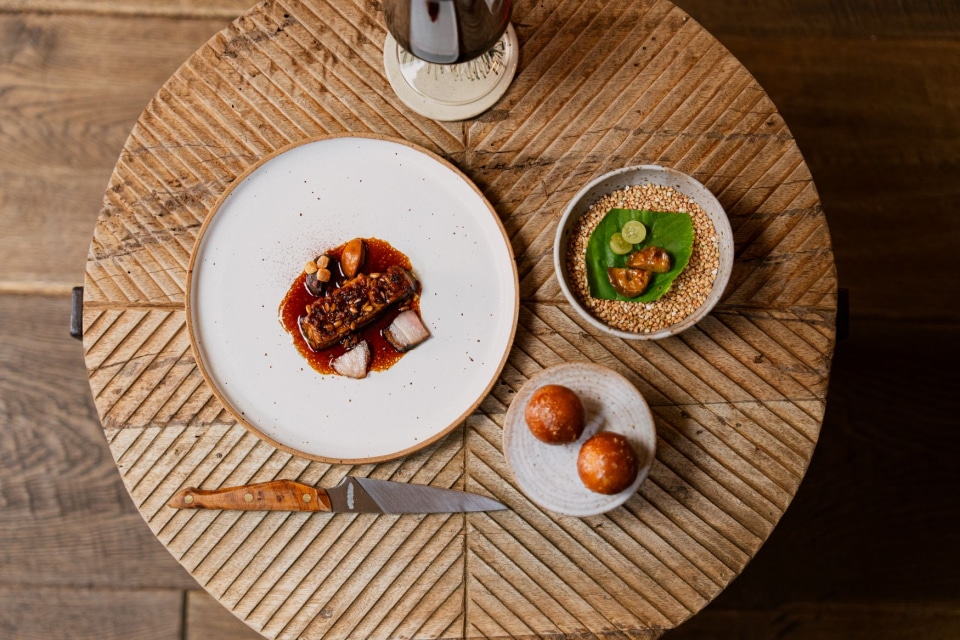
Seasonal and deeply local, first and foremost. Everything on the plate comes from this landscape, and this moment in the year, there’s no menu planning around ingredients we’ve decided we want that then get sourced from wherever they happen to be available. The season tells us what we’re cooking, not the other way around.
Plants and vegetables are very much at the forefront of what we do, most of them grown metres from the kitchen, but we give just as much care and consideration to the meat and fish we serve, which is sourced from farmers and producers we have real relationships with. Nose-to-tail thinking runs through everything, and preservation and fermentation play a central role, not as techniques for their own sake but because they genuinely transform ingredients and create layers of flavour you can’t achieve any other way.
In terms of how it feels to eat, I’d say it moves. There’s real delicacy and lightness in certain dishes, and then real depth and intensity in others. I want guests to be genuinely surprised across the course of a meal, to encounter ingredients and flavours they haven’t met before, to feel the landscape they drove through to get here somehow present in what’s on the plate. It’s ambitious cooking, I think, but it’s rooted in something very real and very specific to this place.
7. Are there any Northumberland ingredients or traditions you feel deserve more international recognition?
Genuinely, the heritage grains coming out of Gilchester Organics deserve far more attention than they get. What they’re doing with ancient varieties, grown organically in this landscape, is producing flours with a flavour and a character that most people, including a lot of chefs, have simply never encountered. The bread we make from those flours is something guests regularly single out, and it’s directly because of the quality of what Gilchester produces.
The game from this region is also outstanding and underappreciated. The gamekeepers we work with have an extraordinary knowledge of their land and the animals on it, and the quality of pheasant, woodcock, wood pigeon and venison that comes from properly managed countryside here is as good as you’ll find anywhere. There’s a perception that game is a niche, slightly challenging thing, but cooked well, with proper respect for the animal and the land it came from, it’s remarkable.
And the foraging tradition here more broadly. The landscape around us produces things, specific pollens, particular coastal plants, and woodland fungi, which are genuinely unique to this environment. I’d love more people to understand what this part of England actually produces if you pay proper attention to it.
8. What is one dish currently on the menu that best represents Restaurant Pine and your philosophy as a chef?
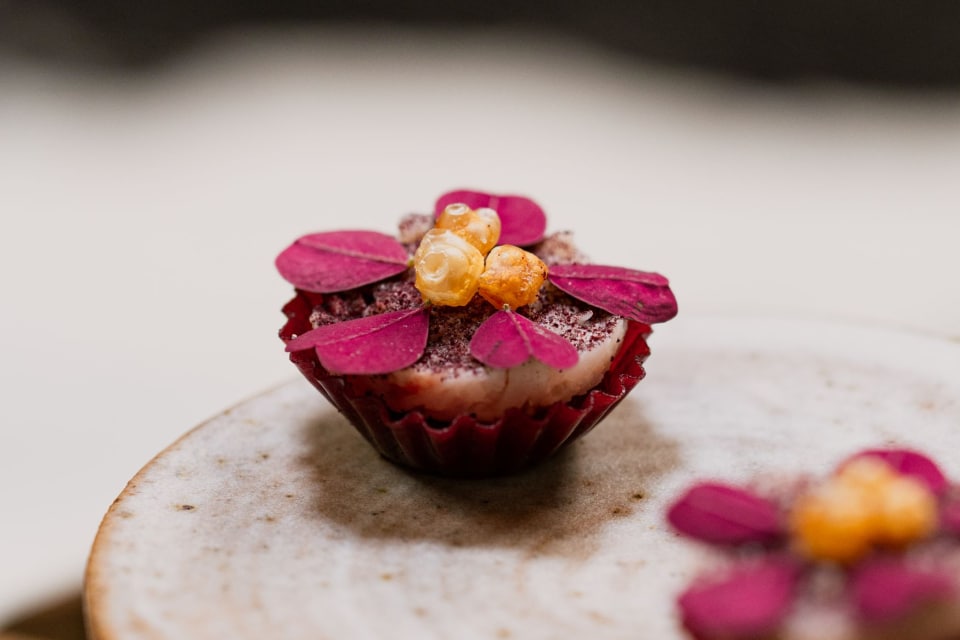
That’s a genuinely difficult question to answer because the menu changes constantly; that’s the whole point. It follows the season rather than the other way around, so pinning down a single dish is a bit like trying to describe a river by pointing at one particular stretch of water.
What represents the philosophy most completely, it tends to be the dishes where preservation or fermentation has done something transformative to a relatively humble, hyper-local ingredient.
But if I’m talking about what represents the philosophy most completely, it tends to be the dishes where preservation or fermentation has done something transformative to a relatively humble, hyper-local ingredient. A dish built around something foraged from the fields and woodlands around us, where the preparation has taken weeks or months, where there’s been real patience and real craft invested in drawing out something that wouldn’t be visible to most people in that raw ingredient.
Those dishes are the ones that feel most completely like Pine to me. They couldn’t exist anywhere else; they couldn’t exist at any other time of year, and they exist entirely because of the commitment to this place and this approach. That’s what I want every dish on the menu to be, even if we’re not always quite there with all of them.
9. Restaurant Pine recently celebrated its fifth anniversary. Looking back, is there anything you know now that you wish you had known when opening?
Probably that the relationships, with producers, with the team, with the community around us, would end up being more central to everything than even I expected, and that they take real time and real investment to build properly. I understood intellectually that working within a ten-mile radius and building genuine partnerships with local farmers and growers was the right approach.
What I didn’t fully appreciate was how much those relationships would grow and deepen over time, and how directly that would feed back into the quality and character of what we put on the plate. The mushroom collaboration with local mycologists, the work with the beekeeping society, the way my family’s farm has become an extension of our own growing operation, none of that was fully formed on day one. It developed because we committed to the place and the people in it.
A team that’s genuinely well looked after brings something to a service that you cannot manufacture any other way.
I’d also say, and this is something Sian has been right about from the beginning, which looking after the team properly, the four-day week, the genuine attention to people’s wellbeing and work-life balance, isn’t separate from the quality of the restaurant. It’s directly connected to it. A team that’s genuinely well looked after brings something to a service that you cannot manufacture any other way. I knew that in theory, but living it every week has shown me just how true it is.
10. What is one simple tip or habit home cooks can adopt to instantly improve the quality of their cooking?
Buy less, but buy better, and buy it as close to where it was produced as possible. I mean that genuinely, it’s not complicated advice, but it changes everything. Most people are cooking with ingredients that have travelled a long way, been stored for a long time, and lost a significant amount of their character in the process, and then wonder why their cooking doesn’t taste the way they hoped. Find your local farmers’ market, find a butcher who can tell you exactly where their meat comes from, and grow even a few herbs on a windowsill.
The moment you start cooking with a vegetable that was picked this morning rather than last week, or with meat from an animal you know something about, the gap between what you produce at home and what you eat in a restaurant closes dramatically. The ingredient does most of the work if you let it.
11. The 360 Eat Guide ranked Pine among the Top 10 English restaurants entering 2026. How do you prevent complacency, and where do you find your next mountain to climb?
Complacency is the thing I’m most wary of, honestly, because it tends to creep in quietly rather than announcing itself. The way we guard against it is by keeping the creative work genuinely alive, and the nature of what we do makes that easier than it might be in a different kind of restaurant. Because we follow the season so closely, because the kitchen garden and the landscape around us are constantly changing, because the producer relationships we have are always developing and throwing up new possibilities, the menu is never static. There’s no point at which we can sit back and run the same dishes indefinitely. The season won’t allow it.
The mycologist collaboration is a good example of where the energy is right now, genuinely exciting varieties being grown specifically with us that are opening up new creative territory. The expansion of our growing spaces, new polytunnels, and additional raised beds will bring ingredients and possibilities we don’t fully know yet. The next mountain, if you want to call it that, is always just ahead of us in the form of an ingredient we haven’t fully understood yet, a producer relationship we haven’t explored, a preservation technique we haven’t pushed far enough.
I also think the broader ambition, which we’ve talked about from the beginning, of demonstrating a model that other restaurants can learn from and build on, that work is nowhere near done. If Pine can play a genuine role in shifting how the restaurant industry thinks about local sourcing, about supporting farming communities, about what a sustainable food system actually looks like in practice, that’s a much bigger and more important project than any award or ranking. That’s what keeps me genuinely motivated when I walk into the kitchen every morning.

Cal Byerley | Instagram
Pine
Vallum Farm, Military Road, East Wallhouses, NE18 0LL, United Kingdom
Feature image courtesy of Linda Hermans
