
Chef of the Week: Gabriel Waterhouse, Waterhouse, London

For chef Gabriel Waterhouse, opening a new restaurant was about more than changing locations. After several years of experimentation at London’s The Water House Project, he wanted to create something more personal, drawing inspiration from the landscapes, ingredients, and food traditions of Northumberland, where he grew up.
The result is Waterhouse, a more relaxed and versatile dining destination that combines an inventive tasting menu with a casual wine bar and sharing-style Sunday lunches. Preservation, fermentation, and produce grown in the restaurant’s own garden are central to his evolving culinary philosophy.
But Gabriel’s ambitions extend beyond what’s on the plate. In a recent essay responding to the controversy surrounding Noma, he challenged an industry culture that has long romanticized aggression, excused abusive behavior, and glorified punishing work hours. He believes it’s time for restaurants to bring the same creativity to leadership and workplace culture that they devote to reinventing food.
We spoke with Gabriel about the challenges of opening his new restaurant, the childhood experiences that shaped his cooking, his vision for modern Northumbrian cuisine, and why it’s time to rethink how professional kitchens operate.
1. You closed The Water House Project in June and opened Waterhouse just a couple of months later. What did you want Waterhouse to allow you to express that you couldn’t quite do at The Water House Project?
The opening of Waterhouse has been an opportunity to redefine what we wanted to be as a restaurant, and my ambitions as a chef. The Water House Project was somewhere we could experiment, treating it almost like a studio, a place to explore our creativity and develop ideas. Waterhouse feels like the culmination of those years of experience, with a clearer sense of identity.
We’re now looking at food through the lens of the North East, and Northumberland specifically where I was grew up. The new space also gives us much more flexibility. The kitchen is less domestic in its design and the offering is more diverse: people can pop in for a glass of wine and a snack at the bar, or experience the full tasting menu in the restaurant. It feels more relaxed and natural.
Our tastes have changed over the past few years, as have dining habits generally. On Sundays, for example, we’re also introducing a more sharing-style menu, which gives us the opportunity to create heartier dishes designed for sharing at the table. Having that flexibility is great for us as a restaurant, but it also gives diners different ways into the world we’re creating at Waterhouse.
2. Opening a restaurant involves far more than developing the food and menu. What was the most challenging part of bringing Waterhouse to life, and was there anything you underestimated before you began?
Honestly, It’s all hard! I think the biggest thing you underestimate is how much has to happen before you can even think about the food and the menu, that’s one of the last things to come together. For us, licensing and negotiating with neighbours was probably the most significant challenge, alongside planning the kitchen, organising deliveries and simply getting everything and everyone into the right place at the right time.
The biggest thing you underestimate is how much has to happen before you can even think about the food and the menu.
There were also things you could never anticipate. Our kitchen was being delivered from Germany and, two weeks before opening, it ended up being held at a depot that was refusing to release it. I drove down to Deptford and sat there for eight hours because I wasn’t leaving until the entire kitchen was on a lorry. That same day, we had a call to say there had been four objections to our licence, so we were suddenly trying to understand how to mediate those too.
Alongside all of that, you’re managing a team through a major transition, keeping people motivated and bringing everyone with you into a completely new space. You can plan an opening as much as possible, but there are always going to be things you simply couldn’t have anticipated.
3. There are so many decisions involved in creating a restaurant that guests may never consciously notice — from the way the kitchen flows to lighting, acoustics, furniture, storage, even how people move through the room. What were some of the less visible details at Waterhouse that required far more thought than people might imagine?
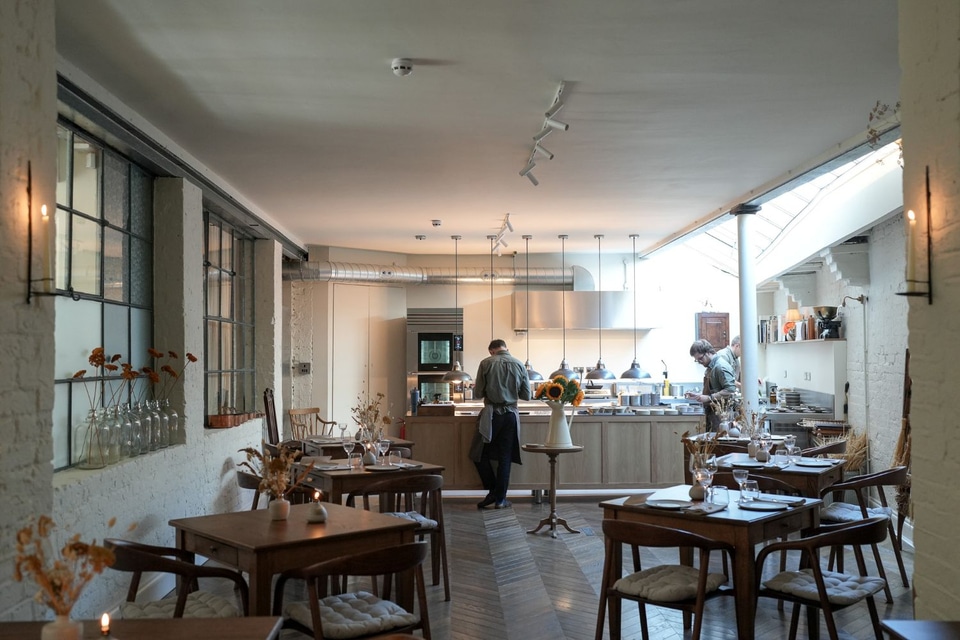
People don’t really ever see everything that happens in the background. The restaurant is open four days a week, but my wife Trish and I haven’t had a day off in several months. There’s always something that needs doing, the admin, accounting, communicating with guests, tastings, managing the team, the to do list is never ending!
The restaurant is open four days a week, but my wife Trish and I haven’t had a day off in several months.
As business owners, there’s always a sense that you could be doing more, and I think you underestimate how consuming that can become. You never completely switch off from it. Opening is obviously the most intense period, but even once you’re open, it isn’t enough to simply run a good restaurant and give people a great experience. You also have to find a way of communicating what you’re doing and why you’re doing it. The challenge is making sure that feels genuine and remains connected to what’s actually happening in the restaurant.
4. You’ve described Northumberland not simply as a place, but as a way of living — practical, generous, and rooted in the land and its rural communities. How do you translate something as intangible as that into a restaurant and onto a plate?
I suppose it’s not just about the food, it’s about how the restaurant feels. We wanted to create something familiar and generous, an extension of how we feel about Northumberland and how we want people to feel when they come into the restaurant. I probably romanticise it, but to me it’s a place where people have more time for each other, where communities are important and people understand the value of relationships.
We already have regulars who have built genuine relationships with different members of the team, and that feels particularly special in a restaurant in London. With the food, it’s about creating dishes that feel familiar to me from home, or using ingredients that have a connection to the region but pushing them in a contemporary and creative way. Northumberland perhaps doesn’t have the same clearly defined culinary identity as somewhere like France, so part of what interests me is discovering what Northumbrian cooking can look like today.
5. Which food memories from your childhood in Northumberland have stayed with you most strongly? Are there particular ingredients, dishes or traditions that have found their way into your cooking today?
My most formative food memory is probably from a bike ride with my family when we came across a hare that had been clipped by a car. The initial idea was to bury it, but it happened to be Good Friday and my dad is a biology teacher, so he decided to dissect it. We then cooked it and made jugged hare, which was my Grandpa’s favourite, and shared it together on Easter Sunday.
It’s probably my strongest food memory because I remember feeling a very real connection to what we were eating. When you’re young your senses are so heightened.
Growing up in Northumberland, there were lots of shoots nearby, so we’d often find braces of pheasants left hanging at the door, which would then become Sunday lunch. My dad taught us how to pluck them, so from quite a young age I was very conscious of where meat came from and the process involved in getting it onto the table, which I think was also why I became vegetarian for such a long time.
6. Preservation is central to the restaurant — vinegars, garums, misos, kombuchas, infusions, pickles. Is preservation primarily a way of extending the seasons for you, or has it become a creative language of its own?
I think it’s a bit of both. Preservation allows us to take ingredients at their best and carry those flavours into another season and is quite integral to the way we structure the menu. Having that acidity, sweetness and brightness from preserved ingredients is particularly valuable in winter, when naturally there’s less of that around.
We’ve been exploring the same idea through the drinks too on our non-alc and standard menu, making tinctures and infusions as we move into autumn so that we can capture interesting flavours and use them throughout the year.
7. You built the restaurant’s raised beds yourself, and the garden is intended to become increasingly important as it matures. How do you hope having produce growing just outside the kitchen will change the way you cook and develop dishes?
It gives you much more insight into what’s actually involved in growing something, and I think you develop a different level of respect for the ingredient as a result. You become much more aware of when something is ready to be picked, how much you suddenly have available and what you’re going to do with it.
That naturally feeds into preservation too, because often everything is ready at the same time. Rather than letting that abundance go to waste, we can preserve ingredients at their peak and use them later in the year. It’s still quite new for us. Over the summer we’ve grown lots of herbs, and as we move into autumn we’re starting to grow hardier things like cabbages and kale. Once those are ready, we’ll start fermenting them. I think as the garden develops, it will increasingly influence the way we cook because we’ll be responding to what’s actually growing just outside the kitchen.
8. Waterhouse has now been open for its first few weeks. What have you learned from actually having guests in the space? Has anything surprised you, or have you already found yourself changing or refining things based on how people experience the restaurant?
You only really understand a restaurant once you start working in it and have guests moving through the space. We have put so much thought into the design of Waterhouse so it’s meant that logistically there’s been far less we’ve needed to change now that we’re open.
Now that we’re settling into the space and understanding how people use it, it feels like we can move beyond those practical considerations and focus more of our attention on developing the food and the wine bar. I’m sure it will continue to evolve, but it’s been reassuring to see the restaurant working in the way we hoped it would.
9. What dish or ingredient on the current Waterhouse menu feels most representative of where your cooking is now?
The first ‘course’ on the menu is our welcome drink, which we serve warm now that it’s getting cooler. We’ve just introduced a vegetable broth made with celery, kohlrabi, celeriac and black garlic. It has loads of depth, but the flavours are still incredibly clean and clear.
For me, it feels like the perfect introduction to what follows and probably represents where my cooking is now and several guests have mentioned it as a favourite at it really nicely sets the tone for the rest of the meal and encapsulates broadly what we do.

10. In your recent Substack essay responding to the debate around Noma, you wrote about the way aggression and chaos in professional kitchens have often been romanticized, even celebrated. What do you think the current conversation about kitchen culture is still getting wrong or oversimplifying?
I think a lot of these things are still romanticised. I’ve been doing a lot of interviews recently to fill roles at Waterhouse, and what has surprised me is how normal extremely long hours still seem to be. I’ve spoken to lots of people who are working 70-hour weeks as a complete standard. It felt for a little bit that there had been a shift slightly away from that, towards implementing more of a work life balance. I think historically there was this idea that intensity itself was something to aspire to – that if you were working incredibly hard and running around constantly, you must be doing a good job. But there’s a lot to be said for efficiency and working intelligently.
What has surprised me is how normal extremely long hours still seem to be. I’ve spoken to lots of people who are working 70-hour weeks as a complete standard.
Someone can produce an enormous amount without appearing manic, and hard work on its own isn’t necessarily a measure of skill. When I was younger, people might have been doing 70-hour weeks, but we were also cooking for 300 people a day with 12 people in the kitchen. Now you sometimes see very large teams in fine-dining restaurants still working incredibly long hours. I think the conversation needs to move beyond simply asking whether kitchens are less aggressive, and look more closely at why people are still working in that way and whether all of those hours are actually necessary.
11. You ended that piece by suggesting that restaurants should show as much creativity in rethinking leadership as they do in reinventing food. What does that look like in practice at Waterhouse?
It comes down to how we communicate with each other and creating a workplace that feels respectful and cohesive. We don’t want there to be an ‘us and them’ mentality, which can still exist in quite traditional restaurant environments.
For us, it’s about being transparent and making sure everyone feels engaged in what we’re doing. I think that naturally filters through to the guest experience too, you can feel when a team genuinely enjoys working together, and we never want that sense of hospitality to feel performative.
12. For people cooking at home: if you could give them just one piece of advice that would noticeably improve the way they cook, what would it be?
Take your time and get organised before you start. Do your prep, keep things clean and tidy and don’t try to do too much at once. Professional cooks might have several things going at the same time, but at home you’ll enjoy the process much more if you focus on one or two things, give them your attention and try to stay relaxed.
13. Finally, if someone visits Waterhouse for the first time, what do you hope stays with them after they leave — beyond the food itself?
The feeling of the restaurant. I’d like people to leave feeling like they’ve been somewhere they could really relax and enjoy themselves, but that still felt memorable and special.

Featured photo credit: Alex Wallace
Gabriel Waterhouse | Instagram
Waterhouse
7A Ezra St, London E2 7RH, United Kingdom
